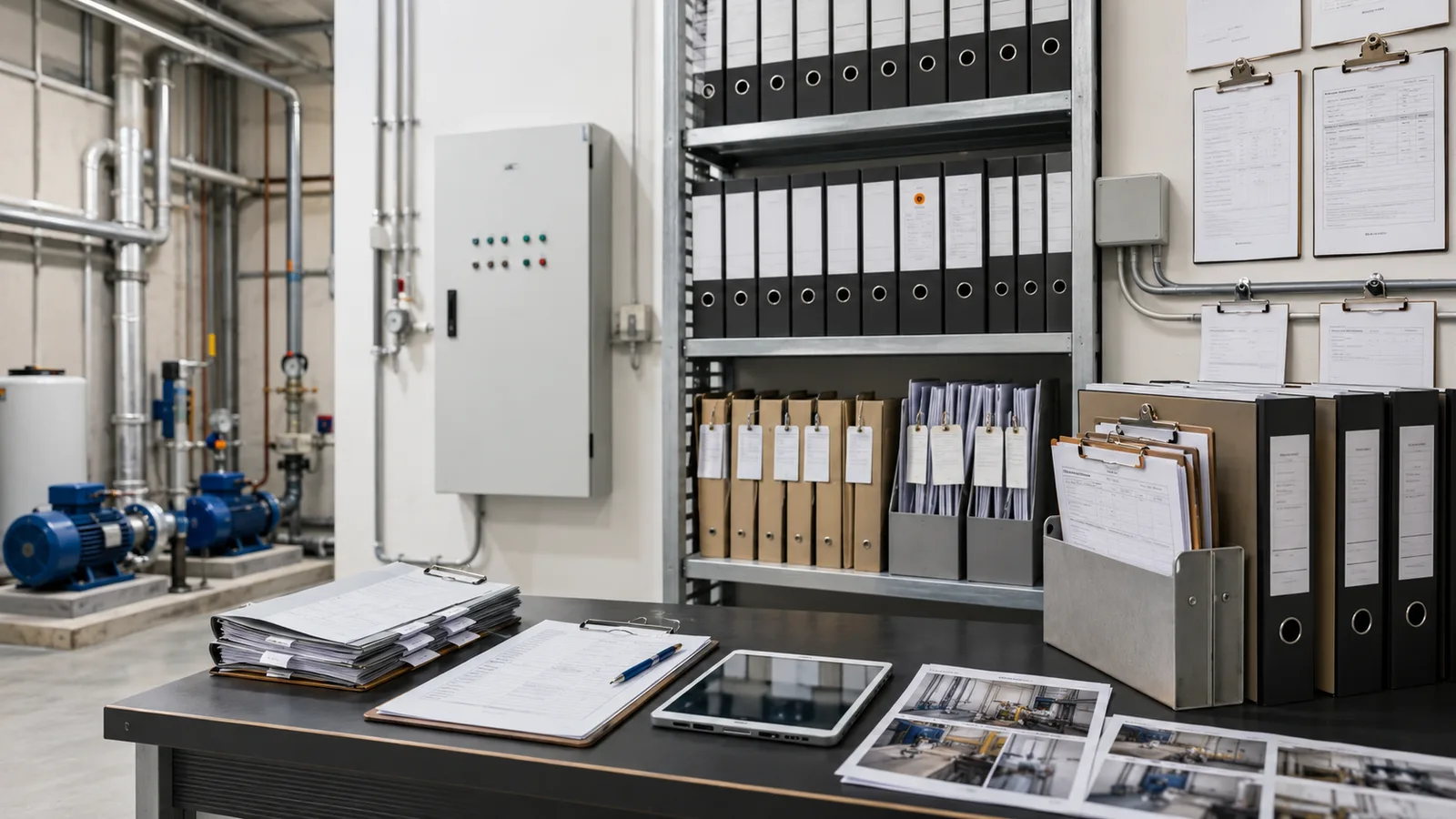
Why maintenance documentation actually matters.
Maintenance documentation protects business continuity, decision-making and technical memory. A business site depends on many systems — electrical panels, pumps, HVAC, hot water, lighting, refrigeration, kitchen equipment, technical rooms, motors, production equipment, IT and security systems, and solar or backup systems where present.
When maintenance lacks documentation, the business loses context:
- repeated faults look like isolated events;
- urgent issues are forgotten between visits;
- temporary fixes silently become permanent;
- different technicians repeat the same diagnosis;
- owners cannot verify what was actually done;
- equipment history disappears;
- small warning signs are missed until they become larger issues.
A good record connects visits, equipment, evidence, repeated faults and decisions so the next visit starts with context.
Conceptual documentation model only — records can be simple, spreadsheet-based or software-based.
Documentation is the site’s technical memory.
A report is important, but documentation is broader than a single PDF or note. A report tells what happened during one visit. A documentation system shows how the site evolves over time.
Maintenance documentation can include equipment lists, visit reports, before/after photos, measurements, staff complaints, recurring fault history, corrective-action lists, spare-parts notes, warranty information and follow-up dates.
A good documentation system should help the business answer simple but important questions:
- Has this happened before?
- What was done last time?
- Did the same issue return?
- Which equipment is most problematic?
- What remains open?
- What should be reviewed next?
What should be recorded after every visit.
Every serious maintenance visit should leave a useful record. The goal is information that can be understood later — by a different technician, by a manager, or by the owner.
A visit record should include:
- date of visit and site area;
- equipment or system checked;
- technician or team involved;
- reason for visit;
- observations, photos and relevant measurements;
- faults found and actions completed;
- parts replaced or recommended;
- unresolved items and urgency level;
- next follow-up;
- manager or client comments where relevant.
A useful record is one that someone else can read three months later and still understand.
Documentation principle
Before and after photos: why they matter.
Photos are one of the simplest ways to make maintenance visible. For owners and managers without a technical background, photos turn abstract reports into clear evidence.
Before/after photos can help show the condition before intervention, what was corrected, visible deterioration, leaks, corrosion, blocked access, poor technical-room conditions, labeling improvements and recurring visible symptoms.
Tracking recurring faults.
A fault that happens once may be an isolated issue. A fault that keeps returning is information.
Typical examples include the same breaker tripping again, the same pump losing pressure, the same rooms having weak cooling, the same corridor flickering, or the same complaint returning after every busy weekend.
Without documentation, these repeated issues are often treated as separate problems. With documentation, the pattern becomes visible — and the root cause is more likely to be addressed.
Recurring faults should become a maintenance record with dates, symptoms, actions and review results.
Pattern recognition
Disconnected events are hard to learn from.
The record shows when the site is repeating the same technical conversation.
Example only — recurring faults should be interpreted by qualified personnel according to site context.
Open actions and corrective tracking.
One of the biggest weaknesses in maintenance is losing problems after they have already been noticed.
A corrective action should record what was found, why it matters, the affected equipment or area, urgency level, recommended action, completion status, owner and review timing.
Open items should remain visible until they are completed, rejected, postponed or replaced by a better action.
Classifying urgency: critical, important, monitor, improvement.
A maintenance report should classify observations so the owner can see what needs action first.
- Critical: safety risk, shutdown risk, serious overheating, major leakage, serious business-continuity risk, or an urgent operational issue.
- Important: a problem likely to worsen, repeat, increase cost or affect comfort/operation if ignored.
- Monitor: not urgent today, but should be watched and reviewed during future visits.
- Improvement: useful optimization, upgrade, reorganization, labeling or reliability improvement — not immediately urgent.
Equipment history: a technical identity card for each system.
Every important system should gradually build a history. For each important equipment or system, documentation should track equipment name, location, function, importance level, known issues, intervention history, parts replaced, photos, measurements, recurring faults and next recommended action.
A pump with three interventions in six months deserves a different review from a pump with no failure history. Equipment history is what allows that distinction to exist on paper instead of staying in one person's memory.
The record keeps the finding, evidence, owner, status and next review visible after the visit.
Conceptual report-to-record flow only — actual content depends on visit scope and site condition.
Staff complaints and operational observations.
Staff often notice problems before they become clear in reports. Typical examples include rooms that are always too hot, pumps that start and stop too often, breakers that trip when the kitchen is busy, areas that flicker every evening, repeated hot-water complaints or machines that stop after long operation.
These observations should be recorded with date, area, symptom, frequency and conditions where possible. Staff feedback is useful context for qualified inspection and pattern detection.
Measurements and technical evidence.
Some findings need more than visual observation. Where useful and appropriate, maintenance documentation may include temperature observations, electrical measurements, pressure readings, runtime or cycling observations, power-quality notes, operating conditions and before/after values once a corrective action is done.
Different measurements require different qualifications. Routine visual checks differ from instrument-based diagnostics, and those differ again from formal power-quality studies or thermographic inspections. The business owner should know whether useful measurements were recorded by qualified personnel when the situation required it.
Spare parts, warranty and supplier information.
Documentation should also help with practical follow-up. Useful records include parts replaced, parts recommended, spare parts to keep in stock, supplier references, warranty status, recurring parts failures, temporary repairs and permanent corrections still needed.
Delays often happen when nobody knows what part was used, who the supplier was, or whether the repair was temporary or final. Good documentation prevents that situation from repeating.
The maintenance documentation checklist.
Use this self-check to evaluate whether your site's maintenance documentation is strong enough. The more boxes you can honestly tick, the closer your site is to a real technical memory system.
Weak documentation vs strong documentation.
Signs of weak documentation:
- no written report; only verbal updates;
- no photos and no equipment history;
- no record of repeated faults;
- no urgency classification;
- no separation between completed and open actions;
- no next follow-up;
- no record of parts replaced or temporary fixes;
- no way to compare visits;
- "everything is fine" with no supporting evidence.
Weak documentation can hide good work because the business cannot clearly verify, track or learn from what was done.
With strong documentation, the owner or manager should know what was checked, what was found, what changed, what remains open, what is urgent, what should be monitored, what keeps repeating and what should be reviewed next time.
Conceptual action board only — tracking can be done in simple documents, spreadsheets or CMMS software.
How ReneWave approaches maintenance documentation.
ReneWave treats maintenance documentation as part of a structured reliability process. For business sites, the objective is to make technical systems visible and traceable over time: what was inspected, what was abnormal, what was corrected, what remains open, which faults are recurring and what should be reviewed during the next visit.
This is especially important when a site has older equipment, undocumented modifications, repeated faults or several technicians intervening over time. Without documentation, every intervention risks becoming isolated. With documentation, the site gradually builds a technical memory.
In ReneWave's approach, a Technical Audit can create the baseline when the site still lacks clear documentation. ReneWcare Max then keeps that visibility useful through structured visit reports, recurring fault tracking, open-action follow-up, maintenance history and practical coordination over time.
The key takeaway.
Maintenance documentation is what turns visits into technical memory. A serious system should track what was checked, what was found, what was corrected, what remains open, which faults are recurring, what evidence supports the findings and what should happen next.
For a business, the goal is clarity: fewer forgotten issues, better follow-up and a more reliable view of the site's technical condition.
Frequently asked questions.
Related guides & services.
Maintenance Guides
All practical guides on planning, scope, electrical reliability and continuity for business sites.
Open GuidePreventive vs Corrective Maintenance
When each one is useful, and how to reduce downtime, repeated failures and hidden technical costs.
Open GuideWhat to Check During a Technical Maintenance Visit
A checklist-style guide explaining what a serious technical visit should inspect, document and report.
Open GuideElectrical Maintenance Checklist for Business Sites
Panels, protection devices, overheating signs, load balance, grounding and recurring faults.
Open GuideHow to Build a Preventive Maintenance Plan
Critical systems, frequency, checklists, documentation and follow-up — for hotels, riads, factories and commercial sites.
Open ServiceReneWcare Max — Structured Maintenance
Inspection, measurement, documentation, preventive planning and warranty coordination where applicable.
Open ServiceTechnical Audit
The baseline assessment when a site has unknown systems, poor documentation or recurring faults.
Open Talk to usDiscuss a Maintenance Need
Send the current reports, recurring faults, open actions, photos and the decisions your team struggles to track.
Open