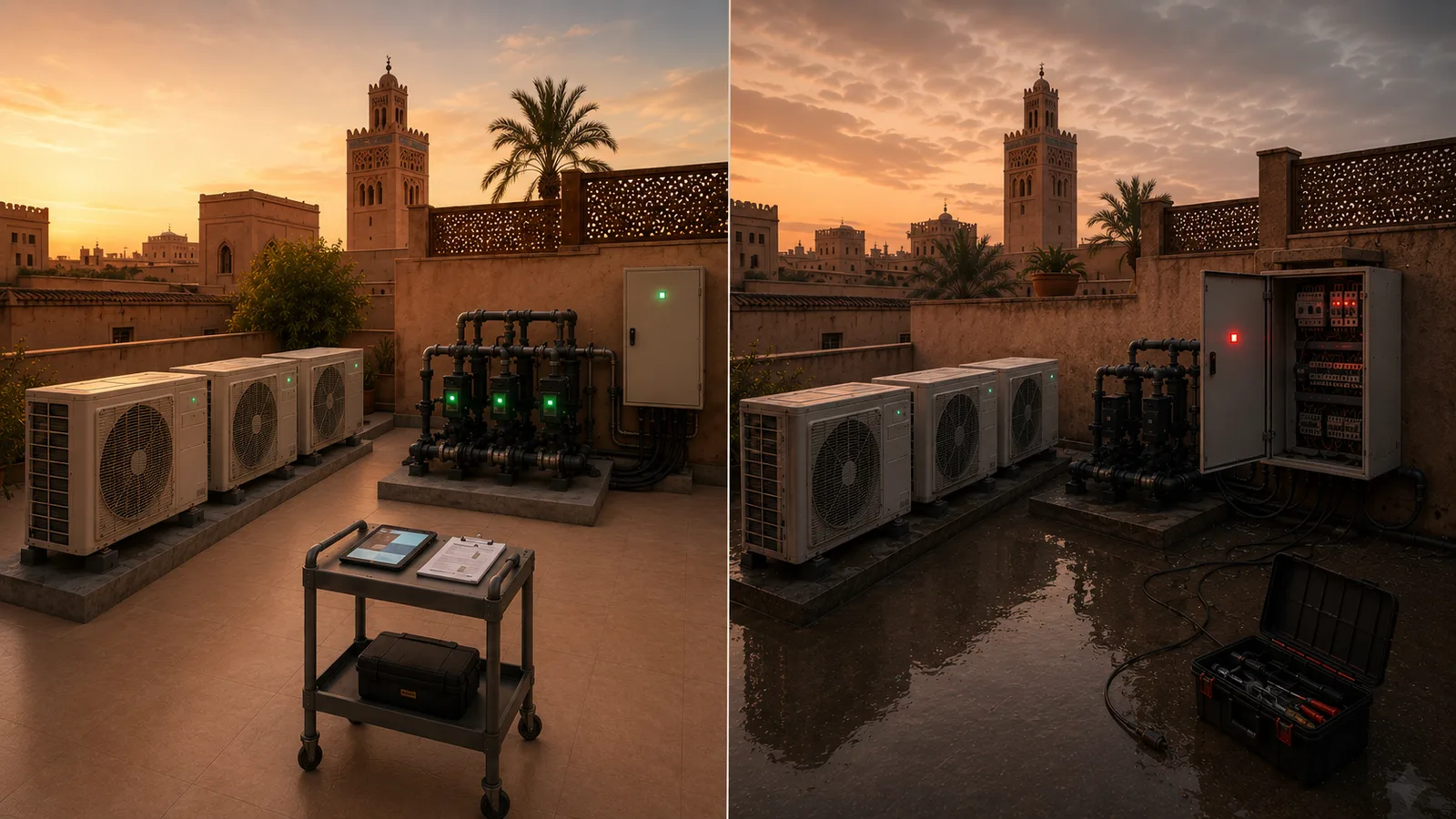
What is corrective maintenance — and why it’s normal.
Corrective maintenance means repairing or restoring equipment after a problem has appeared. In simple terms, something is wrong, and the maintenance action is done to correct it. A pump stops running. A breaker keeps tripping. A panel shows overheating signs. A lighting circuit stops working. A hot water system fails. An HVAC unit no longer cools correctly. A machine stops mid-shift.
Corrective maintenance can be planned or urgent. If a problem is discovered during an inspection and scheduled for repair, that is a controlled corrective action. If the problem appears suddenly and interrupts the site, it becomes emergency corrective maintenance.
Corrective maintenance will always be part of a real site because faults happen. The problem is running an entire business with a “wait until it breaks” approach.
What is preventive maintenance — planned, not random.
Preventive maintenance means planned inspections, checks, measurements, cleaning, adjustments and follow-up actions designed to reduce the chance of failure. Instead of waiting for a visible breakdown, preventive maintenance looks for early signs of technical degradation.
For a business site, this typically includes:
- inspecting electrical panels and protection devices;
- checking for overheating signs and visible wear;
- reviewing repeated faults and the work history;
- inspecting pumps and other technical equipment;
- checking abnormal noise, vibration, smell or heat;
- recording measurements, photos and observations;
- planning corrective actions before they become emergencies.
Preventive maintenance means creating a structured rhythm of inspection, measurement, documentation and follow-up. It is evidence-led, not random replacement.
Planned control vs emergency reaction.
The simplest way to understand the difference is this:
- Corrective maintenance reacts after a problem becomes visible.
- Preventive maintenance creates planned control before failure.
A corrective-only approach often feels cheaper at first because the business only pays when something breaks. But this can hide the real cost: downtime, repeated callouts, guest complaints, emergency stress, unclear history and repairs that treat symptoms instead of causes.
A preventive approach costs money too. It requires planned visits, checklists, reports, measurements and follow-up. But it gives the business more visibility and more control. For a business, the useful cost question is “what does it cost when this system fails at the wrong time?” Count the interrupted operating window, repeated call-outs, staff time, guest or client complaints, spare-part delays and lost technical history.
One waits for failure. The other creates planned control.
Corrective maintenance is necessary. The risk is relying on it as the only strategy.
Why relying only on corrective maintenance becomes expensive.
The repair invoice is usually the easiest cost to see. But in business sites, the largest cost often appears in the disruption created around the failure. A hotel may lose guest comfort. A riad may face repeated complaints about hot water, lighting, pumps or air conditioning. A factory may lose production time. A commercial building may face tenant complaints, repeated interruptions or emergency coordination. A restaurant may lose refrigeration, lighting or water pressure at the worst possible moment.
Corrective-only maintenance can also create technical confusion. If different people intervene each time without proper documentation, nobody has a clear history of what was changed, what was measured, what was temporary and what still needs attention. That makes future diagnosis harder, and the business may keep paying for repairs without understanding whether the root cause has been solved.
Reactive-only maintenance creates a cost stack beyond the repair invoice.
Site formula: repair invoice + interruption window + repeated call-outs + unresolved cause + lost history.
Use the stack as a site-specific formula; impact depends on the system, timing and operating exposure.
A useful maintenance review asks what it costs when a critical system fails at the wrong time, and whether the site has enough history to correct the cause instead of repeating the same intervention.
Engineering principle
When corrective maintenance is acceptable.
Corrective maintenance is normal and necessary when:
- a simple isolated fault appears;
- non-critical equipment fails;
- the repair has low business impact;
- the problem is discovered during a preventive visit and scheduled properly;
- replacing a part after failure is more reasonable than replacing it early;
- the site has a backup or alternative that limits disruption.
Some small components can reasonably be repaired when they fail, especially when failure has limited safety, comfort, production or continuity impact. The risk rises when critical systems depend entirely on emergency corrective work.
When preventive maintenance becomes essential.
Preventive maintenance becomes more important when failure affects the business directly. This includes systems connected to electricity continuity, hot water, guest comfort, pumps, refrigeration, HVAC, lighting, production equipment, safety-related systems, technical rooms, expensive equipment, repeated customer complaints and business reputation.
For a hotel or riad, a technical problem may quickly become a guest experience problem. For a factory, it may become production downtime. For a commercial building, it may become tenant dissatisfaction or repeated emergency interventions. For a business owner, preventive maintenance reduces operational uncertainty by keeping risk, records and follow-up visible.
How to decide what should be maintained first.
A business should classify equipment by priority instead of giving every system the same level of attention. Ask two questions:
- If this system fails, how serious is the impact?
- How likely is this system to fail or create recurring problems?
A system with high business impact should be prioritised — main electrical panels, pumps, hot water systems, HVAC serving guest or working areas, refrigeration, production equipment, and any system with repeated faults or visible overheating, abnormal noise, vibration or wear. Lower-impact systems may still need attention, but with a lighter frequency or level of monitoring.
Prioritize systems by business impact and failure risk.
Protect
Keep documented and periodically checked.
Priority preventive maintenance
Inspect, measure, document and follow up.
Monitor
Simple checks when needed.
Fix recurring causes
Reduce repeated nuisance failures.
Critical equipment deserves planned attention before failure.
Examples are general — final priority depends on the site, equipment, usage and operating risk.
What a balanced maintenance strategy looks like.
A serious maintenance strategy uses both preventive and corrective maintenance. Preventive maintenance is used to inspect, measure, document and reduce risk. Corrective maintenance is used to repair problems when they are found. The difference is that corrective actions should remain visible after the repair.
A balanced strategy should include:
- an equipment list and criticality classification;
- preventive visit frequency and inspection checklists;
- measurements and before/after photos where useful;
- intervention history and corrective action tracking;
- recurring fault tracking and spare parts notes;
- periodic review of the maintenance plan itself.
This creates technical memory. The building has a record: what was checked, what was changed, what failed before, what keeps coming back and what still needs attention.
Good maintenance keeps each fault inside a visible follow-up loop.
Visible record. Clear owner. Next review.
The loop is useful when every open action survives into the next visit.
Conceptual control loop only — the record can be simple, but open actions must stay visible.
Practical checklist: is your site too reactive?
Use this checklist to understand whether your current maintenance approach is mostly reactive. If several of these are true, your site may need a more structured plan.
How to start moving from corrective-only to preventive.
A business can start without building a complex maintenance system on day one. Start with the basics, and grow the plan as the site becomes better understood.
1. List the important systems
Create a simple list of the equipment and systems that matter to the site. For a hotel or riad, this may include electrical panels, pumps, hot water, HVAC, lighting, technical rooms and comfort-related systems. For a factory, it may include production equipment, electrical distribution, compressed air, motors, ventilation and critical utilities. For a commercial building, it may include electrical systems, pumps, lighting, HVAC, water systems and common-area equipment.
2. Identify what is critical
Systems carry different business impact. Ask: what affects safety? What affects comfort? What affects production? What affects guest or client experience? What creates high repair cost if ignored? What has failed before?
3. Define a visit frequency
Some sites need monthly checks. Others may need quarterly or seasonal visits. Some equipment may need more frequent attention than the rest of the site. Frequency should depend on equipment criticality, usage, environment, past failures, manufacturer recommendations where applicable, and business risk.
4. Use checklists
A maintenance visit should use checklists so important points are covered consistently. The checklist should be adapted to the site and should include what needs to be inspected, measured, photographed, cleaned, tested or reported.
5. Document every intervention
Every visit should leave a record. At minimum, the business should know: date, who intervened, what was checked, what was found, what was measured, what was changed, what remains to be corrected and what should be monitored next.
6. Track recurring faults
A repeated fault is a message. If the same breaker trips again, the same pump fails again, or the same comfort complaint returns, the issue should become a recurring-fault record. Recurring faults should be tracked so the root cause can be investigated.
7. Review and update the plan
A maintenance plan should evolve. If a system becomes more critical, if equipment is added, if usage increases or if faults repeat, the plan should be updated. Maintenance is a feedback loop that keeps the calendar honest.
How ReneWave thinks about maintenance.
ReneWave approaches maintenance as a structured system around the technician visit. The goal is to keep technical systems visible, traceable and under control. That means combining inspection, measurement, documentation, preventive planning, corrective intervention scope, recurring fault tracking and clear follow-up actions.
For business sites, this matters because technical systems are connected to comfort, continuity, operating cost, safety and reputation. A useful maintenance plan can stay simple, but it needs structure.
The key takeaway.
Frequently asked questions.
Related guides & services.
Maintenance Guides
All practical guides on planning, scope, electrical reliability and continuity for business sites.
Open GuideWhat to Check During a Technical Maintenance Visit
How a serious visit should prepare context, inspect systems, capture evidence, classify findings and leave useful follow-up.
Open GuideElectrical Maintenance Checklist for Business Sites
Panel condition, repeated trips, critical loads, technical-room evidence and electrical follow-up for business sites.
Open GuideHow to Read a Maintenance Contract Before You Sign
Scope, exclusions, response expectations, spare parts, preventive visits and reporting before signing.
Open ServiceReneWcare Max — Structured Maintenance
Inspection, measurement, documentation, preventive planning and warranty coordination where applicable.
Open Talk to usDiscuss a Maintenance Need
Send the repeated faults, critical systems, current records and emergency repairs so the first maintenance review starts from evidence.
Open