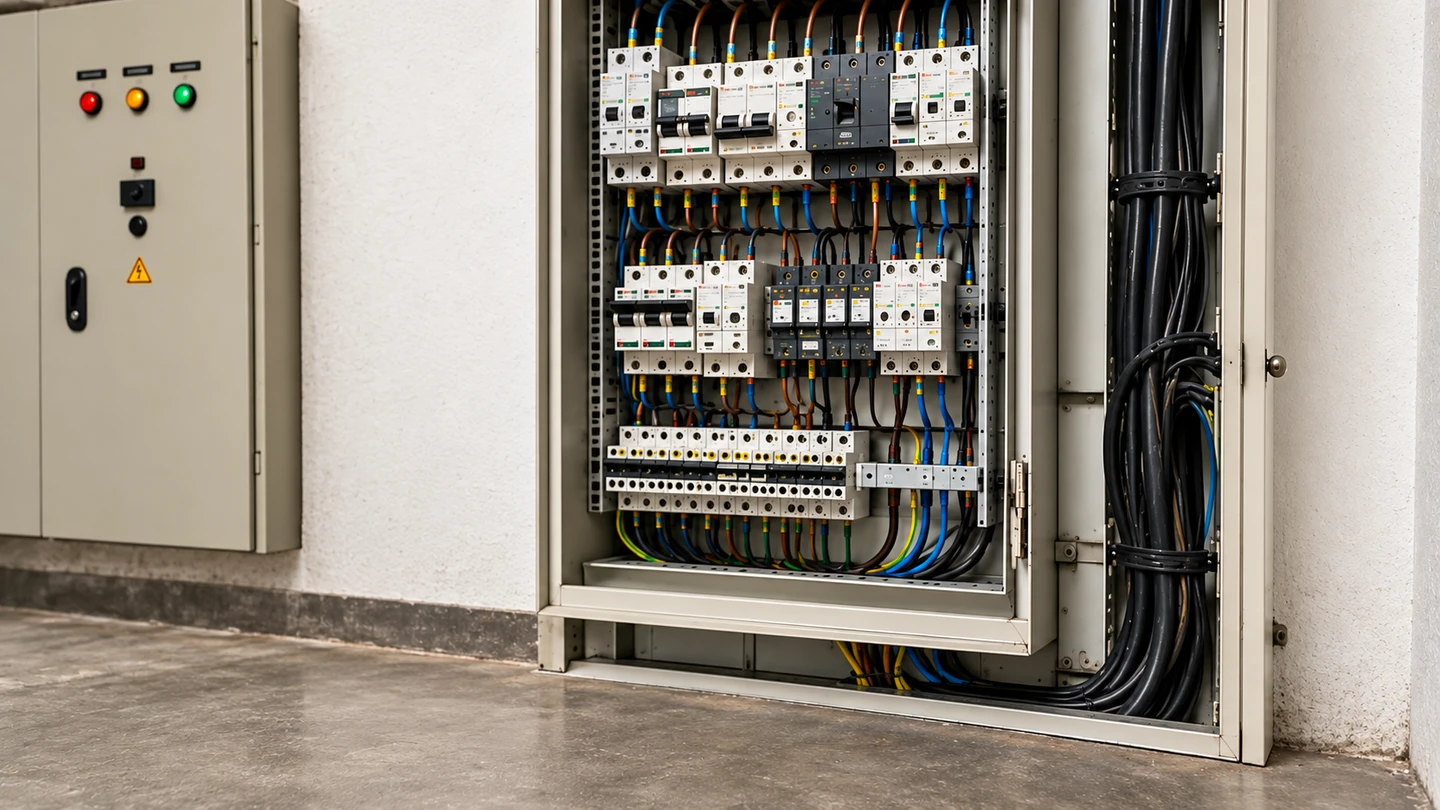
Why electrical maintenance matters for business sites.
Many businesses only think about electrical maintenance when something fails: a breaker trips, lights flicker, a pump stops, an HVAC unit shuts down, or equipment behaves unpredictably. But electrical problems usually begin before the visible failure.
Electrical issues can affect:
- guest comfort and staff productivity;
- safety;
- refrigeration, pumps, HVAC and lighting;
- business continuity and production;
- equipment lifespan and operating cost;
- reputation.
For hotels and riads, an electrical issue can quickly become a guest complaint. For factories, it can become production downtime. For restaurants, it can affect refrigeration, kitchen equipment, extraction, lighting or water pressure. For commercial buildings, it can become tenant dissatisfaction or repeated emergency callouts.
One electrical issue can affect comfort, equipment, operations and continuity.
Conceptual map only — each site has different loads, priorities and risks.
Electrical maintenance looks beyond power on/off.
A system can appear to work while still showing early warning signs. For example:
- a breaker resets but trips again later;
- lights work but flicker regularly;
- a panel operates but shows heat, dust, corrosion or poor labeling;
- equipment runs but fails repeatedly;
- staff know the same circuit causes problems every week;
- new modifications were added but never documented;
- a technical room is accessible but poorly ventilated, dusty, humid, or used as storage.
If the only test is "does it still work?", many early problems will be missed.
Engineering principle
Small repeated symptoms deserve a record before they become urgent.
Conceptual guide only — electrical diagnosis should be performed by qualified personnel.
Electrical panels: what should be checked.
Electrical panels are one of the most important parts of a business site's electrical system. Qualified personnel should review, at a high level:
- visible overheating signs;
- abnormal smell;
- discoloration;
- dust accumulation;
- humidity or corrosion;
- damaged covers or missing protection;
- loose-looking or poorly organized areas;
- panel accessibility and blocked access;
- ventilation;
- labeling clarity;
- signs of undocumented modifications;
- repeated tripping history;
- whether the panel condition matches the importance of the loads it serves.
Protection devices and repeated trips.
Protection devices are there to disconnect power when something abnormal happens. A breaker or protective device that trips is a signal. Repeated trips need a record: affected device, timing, operating conditions, previous action and whether the same fault returned.
A serious maintenance visit should ask:
- Which device trips?
- How often does it happen?
- What equipment is running when it happens?
- Is it linked to time of day, humidity, heat, startup, or high usage?
- Has the same issue been repaired before?
- Was the previous action documented?
- Did the same fault return after a previous intervention?
Repeated tripping should create a maintenance record before the next reset.
Maintenance principle
Loads and business-critical circuits.
A "load" is anything that consumes electricity: pumps, HVAC, lighting, kitchen equipment, refrigeration, motors, IT systems, hot water equipment, production machines and other equipment connected to the site.
Circuits carry different business impact. A corridor light and a refrigeration circuit create different operational exposure. A maintenance visit should help identify which circuits and loads are business-critical.
Common examples of critical loads:
- reception and security systems;
- pumps;
- refrigeration;
- server or IT equipment;
- guest-area lighting;
- emergency or critical lighting where relevant;
- HVAC serving important spaces;
- hot water systems;
- production and kitchen equipment;
- lifts or elevators where present;
- equipment that affects safety, comfort, production or continuity.
Grounding, earthing and protection basics.
Grounding or earthing is part of the electrical safety system. It helps provide a safer path for fault currents and supports the correct operation of protective devices, depending on the system design.
What the business owner should know:
- grounding or earthing needs verification records where relevant;
- it should be reviewed by qualified personnel;
- records and previous tests matter;
- visible deterioration, corrosion or undocumented changes should be taken seriously;
- concerns should be documented and followed up.
Cables, conduits and visible installation condition.
A serious check should look for visible signs such as:
- damaged conduits;
- exposed or poorly protected cable routes;
- poor cable organization;
- signs of heat or discoloration;
- cable routes exposed to water, impact or UV outside their intended conditions;
- improvised modifications;
- temporary cables that have become permanent;
- poor labeling;
- cable routes that are difficult to trace;
- changes that were never documented.
Many business sites accumulate small electrical changes over time. A small temporary fix can become a permanent weak point when documentation and proper correction are missing.
Humidity, dust, heat and technical room conditions.
Electrical systems operate inside real rooms and real weather. Their environment matters. Common risk factors:
- humidity and water leaks near electrical zones;
- dust and blocked ventilation;
- poor housekeeping;
- storage placed in front of panels;
- heat buildup;
- corrosion;
- poor access to panels and equipment;
- technical rooms used as storage rooms;
- panels or equipment exposed to conditions they were not designed for.
A serious electrical check connects panel evidence to operating consequences.
The owner needs to know what was seen, what kept repeating, which load is affected, and what action stays open.
Heat, smell, dust, corrosion, labels, access
Trips, affected device, timing, previous action
Pumps, refrigeration, HVAC, IT, kitchen, production
Conduits, exposed routes, temporary changes, records
Ventilation, humidity, storage, working access
Only where qualified review needs data
Scope should be adapted to the site type, equipment, operating risk and previous fault history.
Power quality and invisible electrical problems.
Some electrical problems appear through behavior rather than visible damage. Power quality describes the quality and stability of the electricity feeding the equipment. Poor power quality can affect equipment reliability, energy consumption and maintenance.
Examples of invisible or less obvious electrical problems:
- voltage imbalance;
- unstable voltage;
- poor power factor;
- harmonics;
- abnormal current draw;
- motors overheating;
- sensitive equipment behaving unpredictably;
- repeated equipment failures without an obvious visible cause.
Advanced analysis belongs where symptoms justify it. When equipment fails repeatedly, motors overheat, breakers trip often, or sensitive systems behave unpredictably, deeper electrical diagnosis may be justified.
Staff complaints and recurring symptoms.
In hotels, riads, restaurants, factories and commercial buildings, staff often notice symptoms before management sees the pattern. Examples:
- "This corridor flickers every evening."
- "This pump trips after heavy use."
- "This room always has electrical issues."
- "The kitchen equipment causes the breaker to trip."
- "Guests complain about power cuts in this area."
- "This machine stops when other equipment starts."
- "There is a smell near the technical room after heavy use."
- "This socket or zone keeps causing problems."
Repeated symptoms are clues that help qualified personnel focus the next review.
Maintenance principle
What should be documented in the electrical maintenance report.
Documentation is what prevents the same electrical problem from being rediscovered again and again. A serious electrical maintenance report should include:
- date of visit and site area;
- panels checked and systems or loads reviewed;
- visible observations and photos where useful;
- measurements where relevant;
- repeated faults and staff complaints;
- critical loads affected;
- urgent risks;
- recommended and completed corrective actions;
- open items and follow-up priority;
- changes made during the visit;
- items to verify on the next visit.
A finding should stay visible after the visit.
Documentation turns electrical maintenance into technical memory.
Conceptual workflow only — final action depends on qualified review and site conditions.
Practical electrical maintenance checklist for business owners.
This checklist helps owners and managers understand what qualified personnel should review, document and follow up.
What a weak electrical maintenance check looks like.
Signs of a weak electrical maintenance check include:
- only checking whether equipment turns on;
- no written report and no photos;
- no repeated-fault history;
- no urgency classification;
- no critical-load identification;
- no follow-up list;
- no documentation of changes;
- "everything is fine" with no evidence;
- repeated breaker trips treated as normal;
- no connection between staff complaints and technical findings;
- no open action tracking.
What a strong electrical check should leave you with.
The owner or manager should know:
- what was checked;
- what looked normal and what looked abnormal;
- which faults keep repeating;
- which loads are critical;
- which risks are urgent;
- what was corrected;
- what remains open;
- what needs monitoring;
- what should be reviewed next time.
How ReneWave approaches electrical maintenance.
ReneWave treats electrical maintenance as part of a structured reliability process: inspect, measure where useful, document, prioritize, correct, and follow up.
For business sites, the goal is to keep electrical systems visible, traceable and under control — because electrical issues affect comfort, continuity, safety, operating cost and reputation.
The key takeaway.
Electrical maintenance should identify warning signs, repeated faults, critical circuits, environmental risks, documentation gaps and follow-up actions before the next incident forces the decision.
For a business, the goal is clarity: what is working, what is risky, what keeps repeating, what needs correction, and what should be checked again.
Frequently asked questions.
Related guides & services.
Maintenance Guides
All practical guides on planning, scope, electrical reliability and continuity for business sites.
Open GuidePreventive vs Corrective Maintenance
When each one is useful, and how to reduce downtime, repeated failures and hidden technical costs.
Open GuideWhat to Check During a Technical Maintenance Visit
Inspections, measurements, photos, reports, urgency levels and follow-up actions for a serious visit.
Open GuideHow to Read a Maintenance Contract
Scope, exclusions, response expectations, spare parts, preventive visits, reports and responsibility boundaries before signing.
Open ServiceTechnical Maintenance Services
Structured maintenance: inspect, measure, document, prioritize, correct, follow up.
Open Talk to usDiscuss a Maintenance Need
Send the site type, repeated symptoms, affected loads, panel photos from normal access, records and current maintenance questions.
Open