ReneWave perspective · Hybrid conversion

    SolaX

    SolaX develops solar inverters, batteries and energy-management systems. Our selection concentrates on low-voltage hybrid inverters: single-phase 6 and 10 kW models, and three-phase 5 to 20 kW models. The useful distinction is how each reference connects solar generation, a compatible battery and the loads that need backup.

    Explore our SolaX products
    SolaX logo
    X1-HYB-LV / X1-Lite-LV / X3-NEO-LV

    Solar, battery storage and a dedicated backup output.

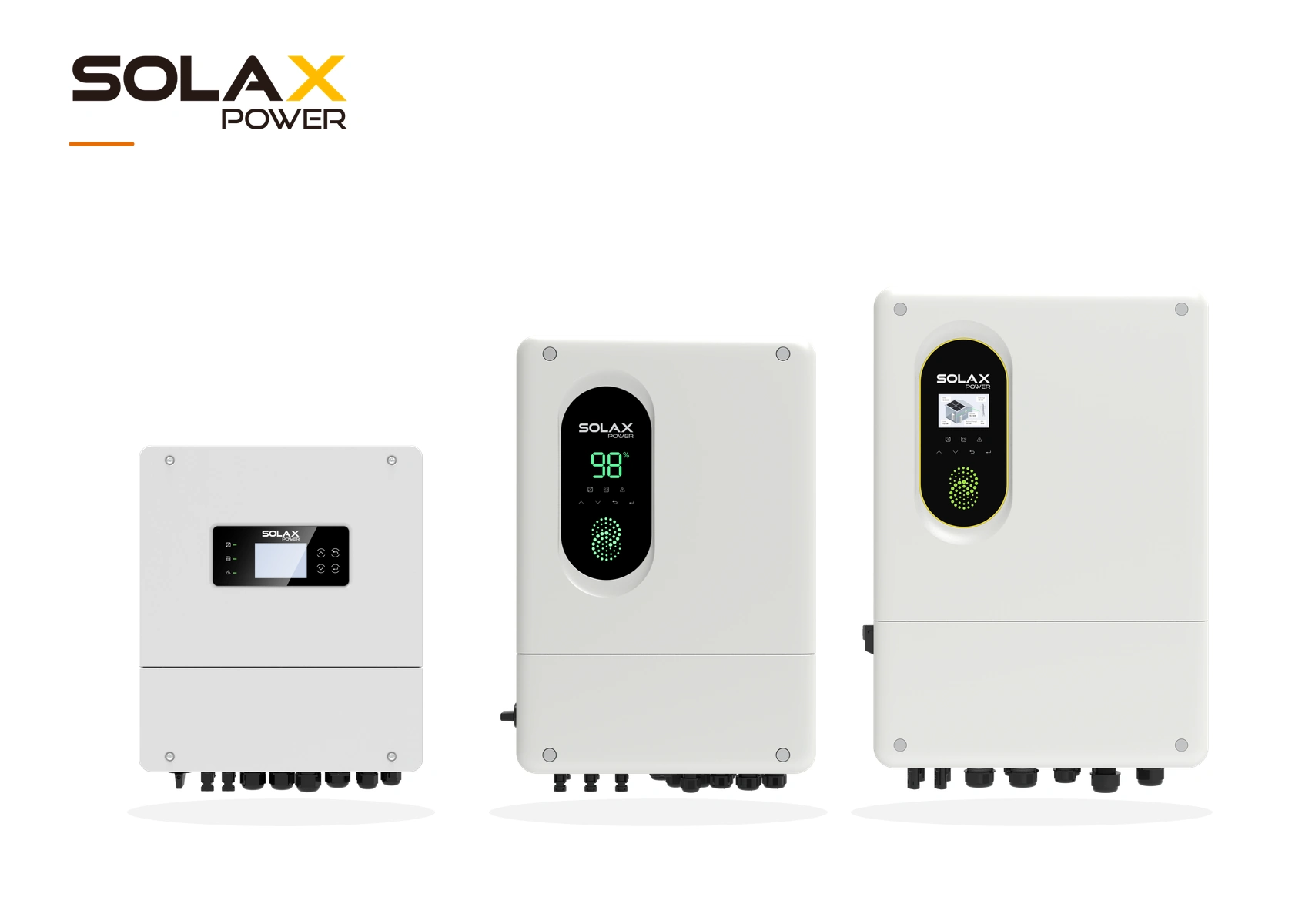
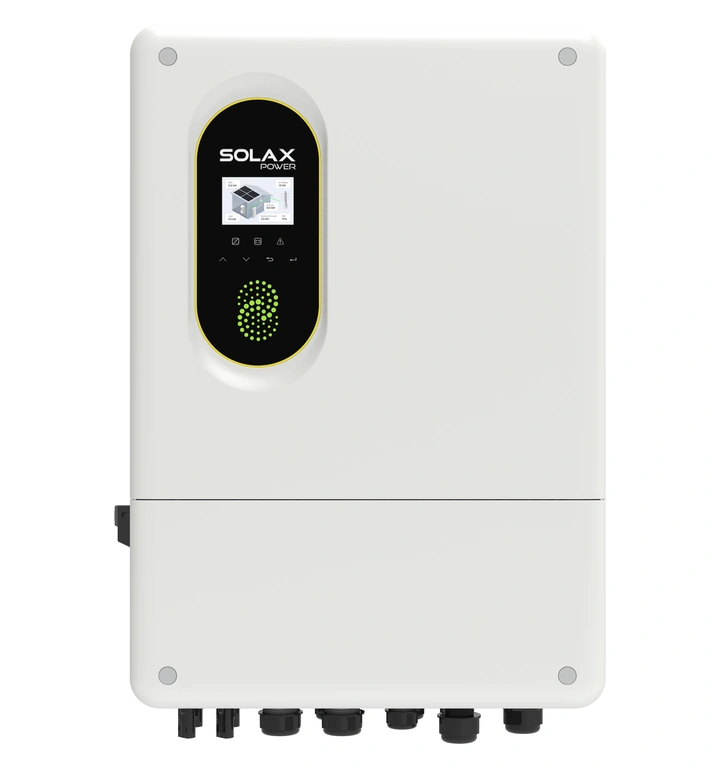
    Authenticated SolaX single-phase X1-HYB-LV and X1-Lite-LV beside a three-phase X3-NEO-LV inverter
    Current family examples, composed from authenticated hardware photographs. Ratings and supplied accessories depend on the exact reference.

    01 / Who they are

    Solar storage at the start of the business.

    Founded in 2012 in Zhejiang, China, SolaX dates the commercial release of its first-generation X-Hybrid storage inverter to 2013. Its published history separates that launch from the company’s foundation. Later milestones include the second X-Hybrid generation in 2016 and the X-ESS G4 inverter-and-battery system documented in 2021. The business expanded from solar conversion and storage into batteries, monitoring, charging and larger energy-storage systems. SolaX Power Network Technology (Zhejiang) was listed on Shanghai’s STAR Market in January 2024 under code 688717.

    Chinese company origin; the supplied unit’s label and records establish its manufacturing origin.

    Expansion, a market correction and renewed sales.

    Revenue rose sharply in 2022, then contracted in 2023 and 2024. Its 2023 report describes European channel inventories and lower electricity prices; the 2024 report records weaker demand and stronger competition. In 2025, consolidated revenue recovered by 32.84% in CNY, supported by expanding sales in Asian and Australian markets. Revenue recovery did not mean profit recovery: lower-margin sales and increased expenditure reduced attributable net profit. These figures describe the group, rather than the six inverter references in our catalogue.

    Revenue trend · USD billion
    Annual revenue trend, 2021–20252021: $0.129; 2022: $0.685; 2023: $0.632; 2024: $0.427; 2025: $0.568. Values in USD billion; vertical axis starts at zero.$0$0.175$0.35$0.525$0.72021$0.1292022202320242025$0.568
    Annual revenue · USD billion
    YearRevenue
    2021$0.129
    2022$0.685
    2023$0.632
    2024$0.427
    2025$0.568

    Consolidated operating revenue, 2021–2025, in USD billion, rounded to three decimals. Original CNY accounts are converted using each year’s Federal Reserve average CNY/USD rate. Currency translation affects the trend; these are completed years, not forecasts.

    Business milestones

    1. The first X-Hybrid storage inverter

      The company’s history records its first-generation storage-inverter release. Solar conversion and battery control were already central to the business; this is not the launch date of today’s LV references.

      Current X1-HYB-LV manufacturer photograph
      Current LV illustrative example; not the original 2013 device.
    2. A listed business and a broader LV range

      The January stock-market listing followed the earlier hybrid generations. Its 2024 product history also records the X1-Lite-LV launch, extending the single-phase low-voltage battery offering. The catalogue’s 10 kW reference belongs to this family.

      Authentic X1-Lite-LV manufacturer family view
      X1-Lite-LV illustrative example; exact model ratings vary.
    3. Sales recover while the portfolio widens

      The annual report documents renewed group revenue growth and expansion into larger storage systems. Our selection remains focused on individual LV hybrids; the X3-NEO-LV illustrates its three-phase branch, without implying that every manufacturer system is sold here.

      Authenticated current X3-NEO-LV family view
      Current three-phase LV illustrative example; not a launch-year claim.

    02 / Technology

    Selected technology advances

    Selected developments in the brand’s specialty, not a complete history or catalog.

    These three LV families are parallel choices for different power and phase requirements. They are not three successive generations, and a higher model number does not establish universal superiority.

    Current X1-HYB-LV manufacturer photograph
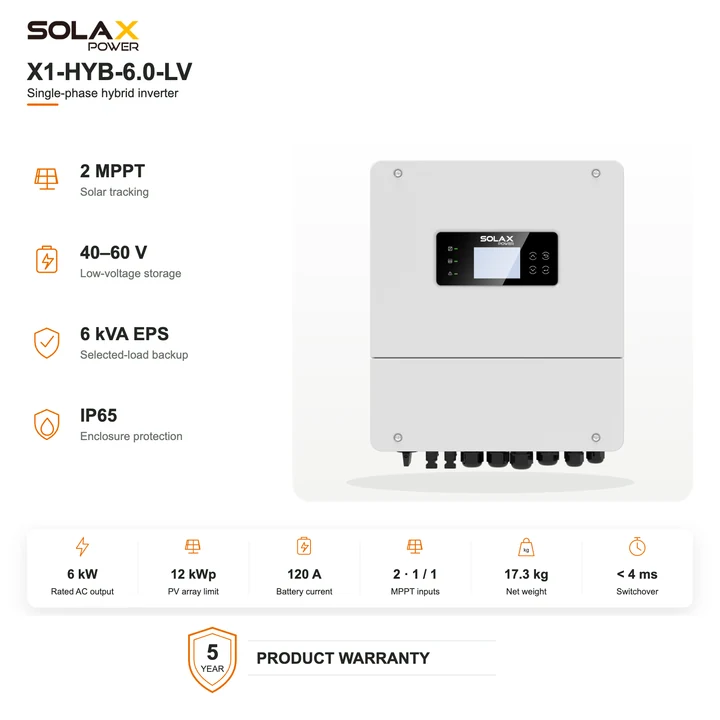
    X1-HYB-LV current family example; ratings depend on the exact reference.

    X1-HYB-LV

    Compact single-phase hybrid

    For our X1-HYB-6.0-LV, the two MPPTs accept one string each, with 16 A per tracker. The battery interface is 40–60 V and up to 120 A. The 6 kVA backup output has a stated transfer time below 4 ms. The unit weighs 17.3 kg.

    A smaller single-phase format when the solar strings and backup demand fit these limits.

    The 12 kWp recommended PV limit does not make this a 12 kW AC inverter.

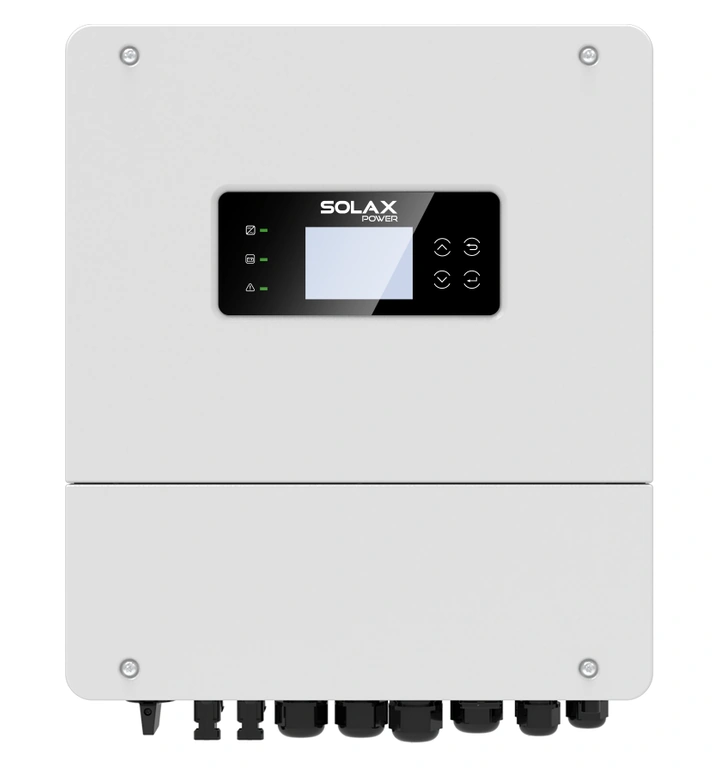
    Authentic X1-Lite-LV manufacturer family view
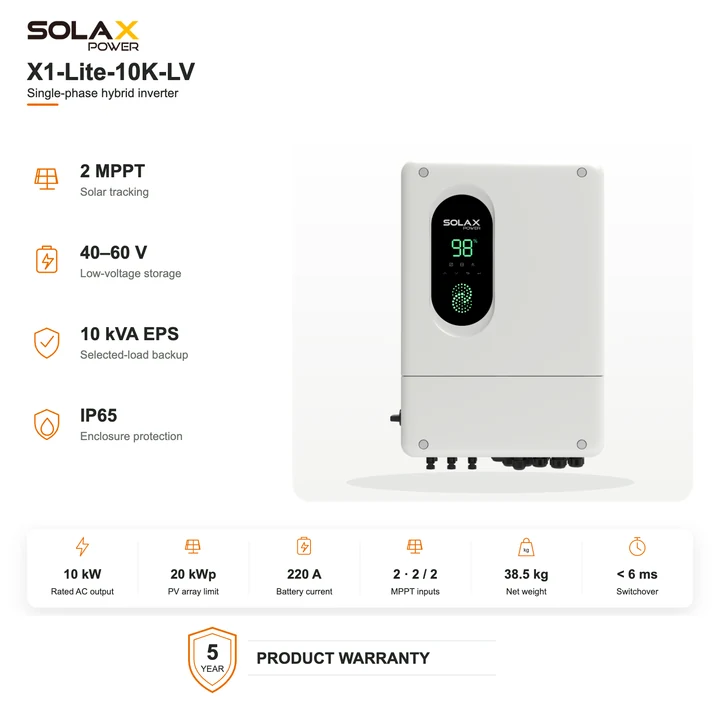
    X1-Lite-LV current family example; ratings depend on the exact reference.

    X1-Lite-LV

    Higher-power single-phase hybrid

    The X1-Lite-10K-LV raises rated output to 10 kW and battery current to 220 A. Its two MPPTs accept two strings each, up to 32 A per tracker. The recommended PV array reaches 20 kWp, maximum PV voltage is 600 V and stated backup transfer is below 6 ms.

    More single-phase load capacity and parallel-string allowance, with larger battery-current requirements.

    Two MPPTs remain two independent trackers, even with four string inputs. Battery and thermal limits still apply.

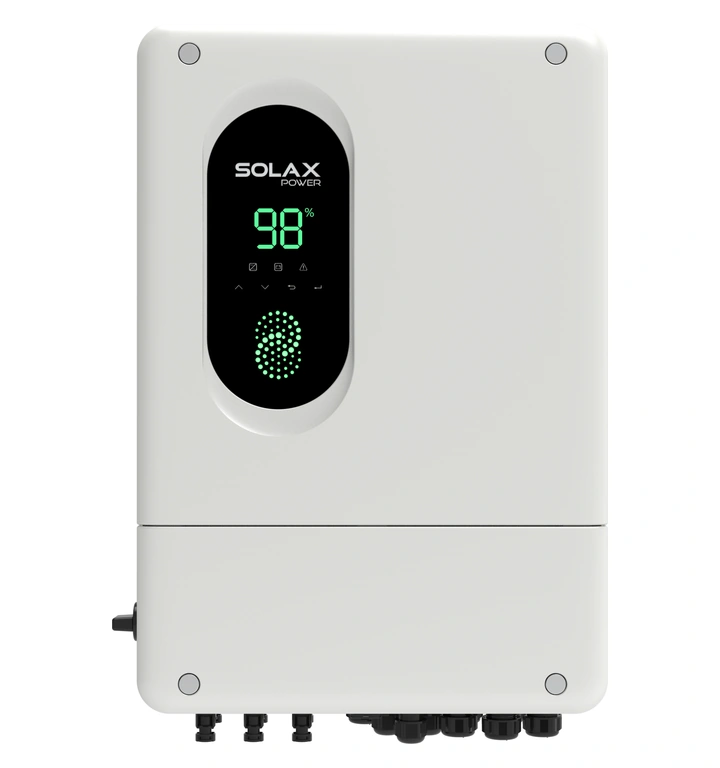
    Authenticated current X3-NEO-LV family view
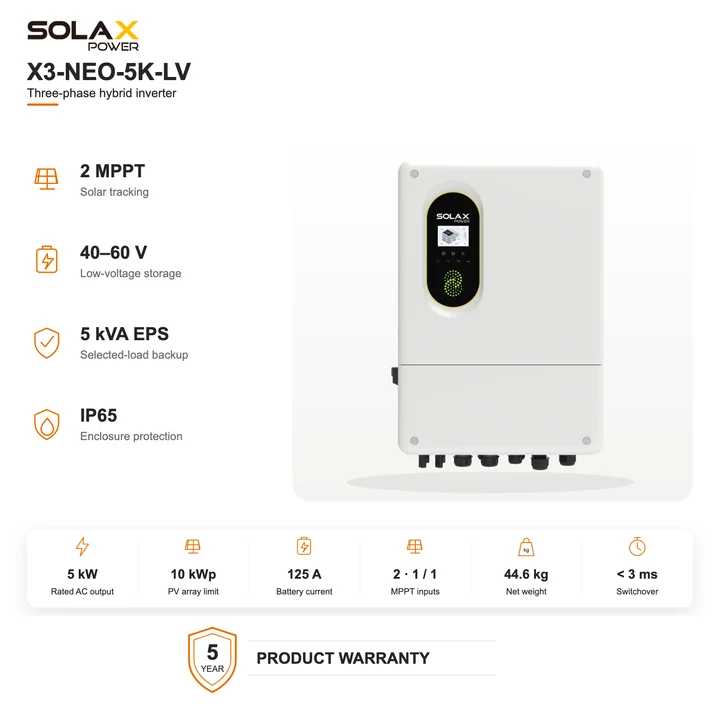
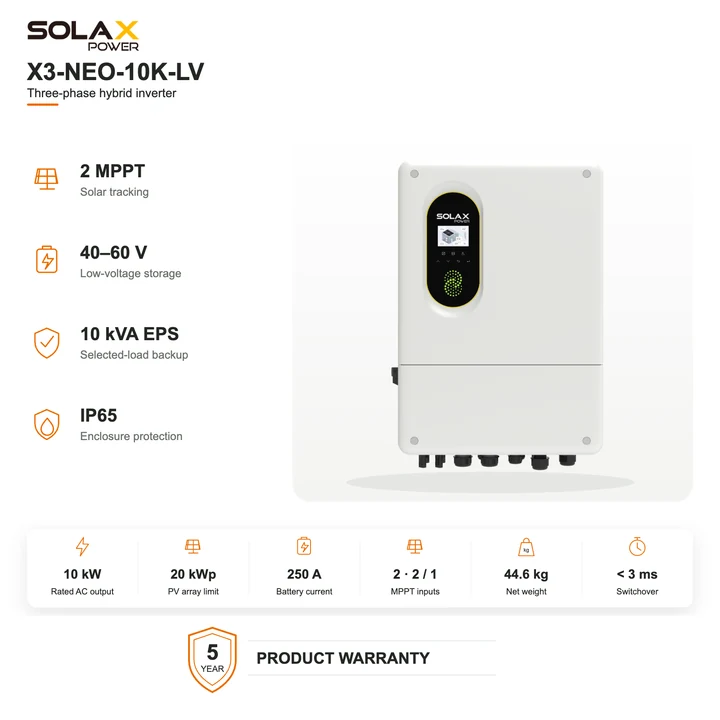
    X3-NEO-LV current family example; ratings depend on the exact reference.

    X3-NEO-LV

    Three-phase low-voltage hybrids

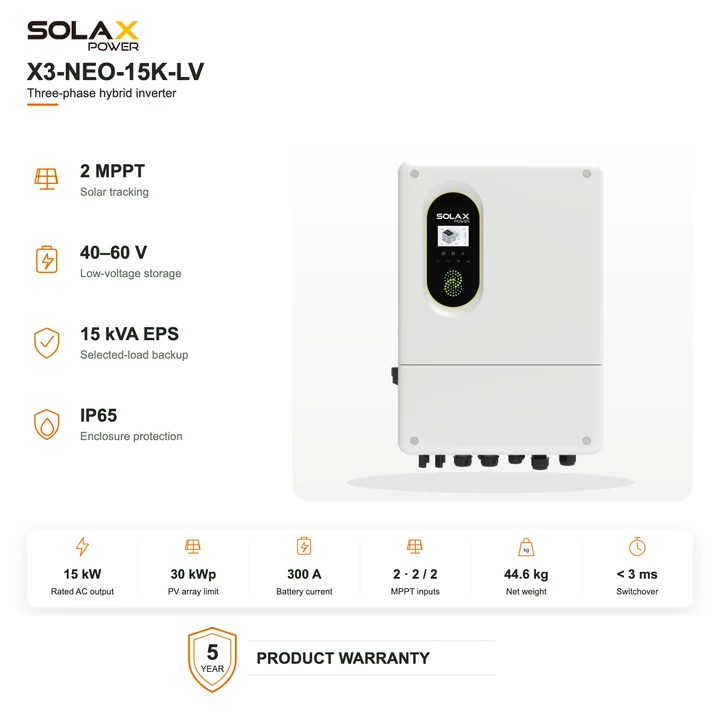
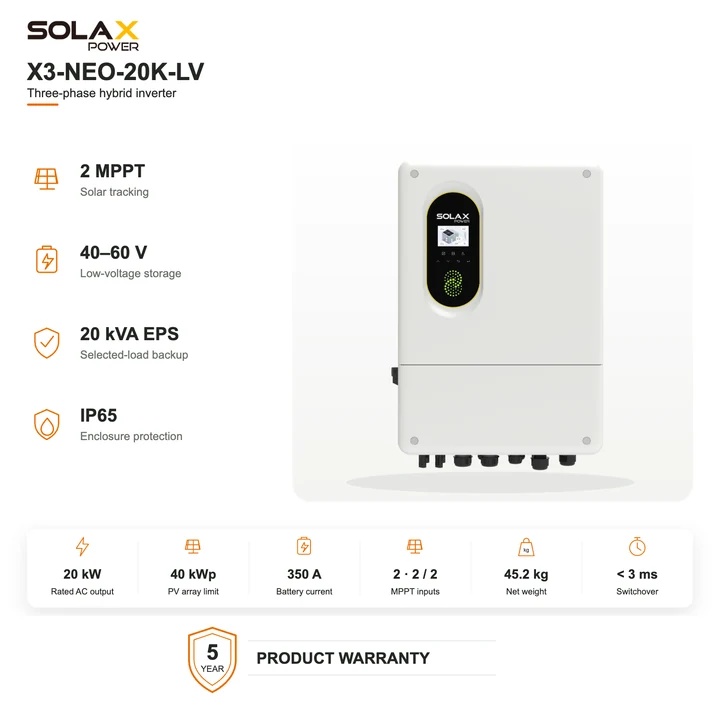
    Our 5, 10, 15 and 20 kW references share two MPPTs and a 40–60 V battery interface. Model-dependent battery-current limits are 125, 250, 300 and 350 A. Stated backup transfer is below 3 ms. The 5 kW model uses natural cooling; the larger listed models use controlled air cooling.

    Choose by the three-phase load profile, including the heaviest individual phase, rather than total kW alone.

    On the 20 kW reference, continuous unbalanced output is limited to 7.5 kW on one phase. A 20 kW label does not mean 20 kW available on each phase.

    Key terms

    Short definitions for the names used in this guide.

    X1 / X3
    Single-phase / three-phase in the selected inverter families.
    LV
    Low-voltage battery interface: 40–60 V here. The solar input operates at a different, much higher voltage.
    MPPT
    Independent solar tracking. Two strings on one MPPT share its tracking and current limit.
    EPS
    Dedicated backup output. Supported loads, battery state, protection and wiring determine useful backup operation.

    Model suffixes identify the architecture; a shared brand does not make every battery interchangeable.

    03 / What stands behind the brand

    Best Value

    What supports our selection

    Three concrete advantages, with the conditions that make them useful.

    Best Value is ReneWave’s commercial positioning for this selection. The interfaces, power range and documented operating limits below explain that choice.

    Solar inputs sized to the reference

    The HYB 6 kW accepts 16 A per MPPT; Lite 10 kW accepts 32 A. This changes parallel-string options. The NEO family varies again by reference, so cold-weather voltage, string count and total short-circuit current still need checking.

    A separate backup path

    The listed HYB, Lite and NEO families state transfers below 4, 6 and 3 ms respectively. This supports suitable backup loads when the dedicated output is correctly designed. It is not an unconditional no-interruption promise for every appliance or an automatic whole-site backup.

    A shared low-voltage battery architecture

    Our range spans 6–10 kW single-phase and 5–20 kW three-phase while retaining a 40–60 V battery interface. That makes architecture comparisons straightforward. At the higher ratings, current, supported battery communication and per-phase limits become decisive.

    Published characteristics are useful evidence, not a promise of trouble-free operation or fast local warranty handling. Newer models do not inherit decades of field history from the company’s age.

    05 / Warranty & buyer questions

    Warranty coverage

    The current global policy names these LV families. Eligibility, supply channel, installation and registration conditions still govern the supplied unit; regional advertising alone does not establish its coverage.

    5 years

    Standard LV inverter warranty

    Global policy V1.7 lists five years for X1-Hybrid-LV, X1-Lite-LV and X3-NEO-LV. It starts at first installation or six months after production, whichever is earlier. The policy applicable at purchase controls the unit.

    Conditional extension to ten years

    For these LV families, the policy requires pairing with a SolaX battery, SolaXCloud connection and successful upload of generation data for the free upgrade. Supply and installation eligibility still apply. Ten years is not the unconditional warranty of every inverter sold alone.

    Questions before you buy

    The catalogue on this page shows the references currently displayed. Our selection focuses on single- and three-phase LV hybrids; each product page gives its exact ratings, price and documents.

    No. The 40–60 V electrical window is only one requirement. Check the exact battery, BMS communication, firmware, permitted charge/discharge current and manufacturer compatibility documentation. One battery may be unable to deliver the inverter’s full rated power.

    Backup uses a dedicated output and a designed load schedule, with an adequate supported battery and the required protection and isolation. Motor starting, phase imbalance and sustained power matter. The product diagrams distinguish grid-connected operation from isolated backup.

    Use the supplied model, serial number, production date, purchase and installation records, and the policy applicable at sale. Confirm the supply and installer eligibility and any registration or cloud conditions in writing. A claim follows the manufacturer’s procedure and diagnosis; the general policy does not promise a local repair deadline.

    Each product links to retained original datasheets, manuals and installation guides. The Technical Library offers viewing and download through ReneWave links. English originals remain available when no standalone French edition was verified; some installation guides include French sections.

    Understand the brand. Choose the exact reference.

    Sources · Reviewed 18 October 2026

    ReneWave is independent of SolaX. Manufacturer names and marks belong to their owners; this guide implies no authorization or endorsement.

    ReneWave markRENEWAVE

    Energy systems, held to standard.