What a technical audit should actually check.
The first job of a technical audit is to understand the current technical condition before recommending a solution. Without that step, a site can jump too quickly toward repair, replacement, solar, backup, a maintenance contract or deeper diagnosis without knowing whether the underlying condition supports that decision.
A useful audit looks at the systems that keep the business operating: what is critical, what is visibly deteriorated, what keeps failing, what is undocumented, what is difficult to access, what needs qualified diagnosis and what can be handled through planned maintenance. It should help management understand the site, not turn the report into a long list of disconnected remarks.
The value comes from a documented baseline and a practical action plan.
Audit principle
Start with the systems the business depends on.
Every business site has a different risk profile. A riad may depend on hot water, kitchen ventilation and guest-room comfort. A restaurant may depend on refrigeration, extraction and kitchen equipment. A factory may depend on motors, pumps, production equipment and power continuity. A commercial building may depend on lighting, ventilation, lifts, HVAC and technical-room access.
Electrical rooms matter, and the audit also has to identify the systems that affect comfort, production, safety visibility and business continuity. Priority follows operating consequence: the loads and rooms that stop service, disrupt production or expose staff pressure deserve the clearest evidence first.
The audit reads the whole operating site, then separates urgent risk, planned work, maintenance, monitoring and deeper diagnosis.
Electrical condition should be reviewed at a safe owner level.
Electrical condition is often part of a technical audit, especially when there are repeated trips, unclear technical rooms, old installations, missing labels or sensitive equipment problems. The audit should stay at a safe decision level for owners and managers: visible condition, access, labeling, signs of unclear modification, repeated symptoms and missing documentation.
Electrical repair, breaker sizing, cable selection and installation changes belong with qualified personnel. If the audit finds electrical symptoms that require technical work, the output should say what needs qualified review and why it matters operationally.
- Visible condition. Unclear, damaged or poorly organized areas that require qualified attention.
- Access and labeling. Whether technical rooms and equipment can be safely identified and reached.
- Repeated symptoms. Trips, unstable behavior or recurring faults that should be treated as patterns.
- Documentation gaps. Missing records that make future maintenance and responsibility unclear.
Recurring faults deserve a different reading.
A single failure can be simple. A repeated failure is information. If the same pump is repaired several times, the same protection device trips during busy hours, or the same comfort complaint returns every season, the audit should stop treating each event as separate.
In practice, this often appears as scattered history. A technician remembers one visit, the operations team remembers another, and the invoice only says that the problem was corrected. The technical audit collects those fragments and looks for a pattern: where it happens, when it happens, what was running, what was replaced, what was never documented and what still needs qualified diagnosis.
One symptom can be noise. Repetition becomes information.
A clear isolated fault can still deserve a quick intervention. The risk appears when the site keeps paying for resets without technical memory. A simple exposure count is useful here: repeated call-outs, affected operating periods, replaced parts and open symptoms. Over time, that can mean wrong replacement decisions, delayed root-cause diagnosis and higher exposure to downtime.
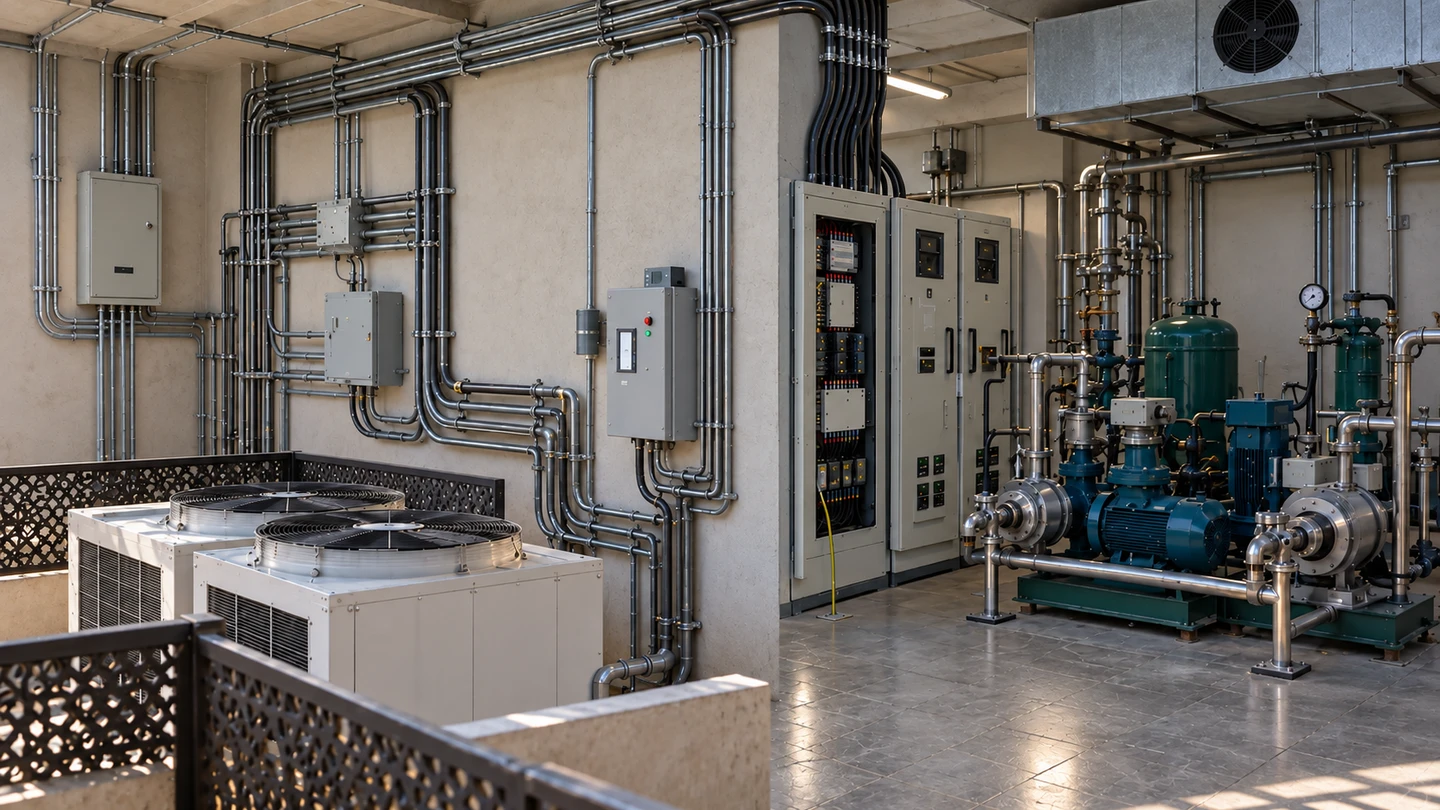
Technical rooms can reveal how maintainable the site is.
A technical room shows whether future maintenance will be easy, safe to organize and traceable. Access, cleanliness, ventilation, labeling, environmental condition and general organization all influence how quickly problems can be found and followed.
In a hotel or restaurant, a technical room that hides labels, blocks access or mixes unrelated materials can turn a small issue into a slow intervention. In a factory, poor visibility around pumps, motors or electrical areas can delay diagnosis during production pressure. The audit should make those practical barriers visible without turning the article into a repair manual.
Maintenance history needs a written path.
Missing documentation is one of the most expensive forms of technical uncertainty. When records are weak, every new technician starts from zero. The same symptom can be corrected repeatedly, responsibility becomes unclear, and routine maintenance gets mixed with urgent corrective work.
A technical audit should review what history exists: visit reports, photos, open actions, intervention dates, equipment notes, repeated faults, previous recommendations and missing records. The purpose is practical: make the condition visible and the next action traceable.
The audit should reflect how the site actually operates.
Equipment condition needs operating reality. A pump serving occasional use carries a different consequence from a pump serving daily production. HVAC serving a mostly empty building carries a different consequence from HVAC serving a fully occupied riad in August. A cold room serving a quiet cafe carries a different consequence from one protecting a restaurant’s daily stock.
The audit should therefore connect observations with occupancy, kitchen hours, production rhythm, peak periods, seasonal use, staff feedback and business-critical loads. Staff observations are important here. Operators often know when the symptom appears, even if they do not know the technical cause.
For example, repeated evening trips in a busy kitchen may be meaningless if described only as “electrical problem.” When the audit connects it to kitchen hours, ventilation, hot water, refrigeration and the technical room, the site gets a clearer direction for qualified review.
Measurements should answer a real question.
Measurements, thermography, logging, equipment testing and power quality studies can be valuable when they answer a decision question. The practical check is simple: will this measurement change what the site corrects, monitors, budgets, replaces or investigates?
If the issue is poor documentation, the first step may be records, photos and scope clarity. If the issue is repeated unexplained trips, unstable equipment, motor problems or sensitive electronics behavior, deeper electrical diagnosis or power quality review may be justified. If overheating is suspected, thermography may be relevant when performed and interpreted by qualified personnel.
Deeper diagnostics belong where symptoms justify them and the site baseline is clear enough to make the result usable.
Audit boundary
Findings should become clear action categories.
A weak technical audit leaves management with a long observation list. A useful audit classifies findings so the next decision is obvious enough to discuss, approve, budget or monitor. The same site may have one urgent correction, several planned corrections, routine maintenance items, one monitoring item and one issue that needs deeper diagnosis before any replacement decision is made.
Classification protects the business from spending in the wrong order. It separates what is urgent from what is important, what is maintenance from what is corrective work, and what requires investigation before anyone proposes new equipment.
Weak technical audit signs to watch for.
Before approving an audit, it is worth asking what the provider will actually deliver. A well-scoped audit explains what will be reviewed, what will not be reviewed, how findings will be documented and how priorities will be separated.
- Observation list only. Many comments, but no priority, cause logic or next-step classification.
- No traceable evidence. No photos, no records, no clear location of what was observed.
- No urgency separation. Routine maintenance and urgent correction are mixed together.
- Replacement without cause. New equipment is recommended before the fault pattern is understood.
- Missing recurring-fault analysis. Repeated symptoms are treated as isolated incidents.
- Unclear diagnosis boundary. The report leaves deeper qualified investigation vague.
The useful audit can stay concise. It should avoid a polished document that still leaves the business asking the same question: what should we do first?
How ReneWave approaches technical audits.
ReneWave starts with the baseline before the recommendation. We look at the site objective, critical systems, operating reality, visible condition, recurring faults, documentation, maintenance history and symptoms that may justify deeper diagnosis. The audit scope is adapted to the site instead of forcing every business into the same checklist.
Findings are then classified by what they mean operationally: urgent correction, planned correction, maintenance action, monitoring item, deeper diagnosis, efficiency opportunity or investment and replacement decision. This baseline can support ReneWcare Max, corrective work, solar readiness, equipment replacement planning or specialist diagnosis where appropriate.
- Baseline before recommendation
- Evidence before diagnosis
- Recurring-fault pattern before repeated correction
- Classification before investment
- Technical memory before maintenance planning
- Deeper studies only when symptoms justify them
The key takeaway.
A technical audit checks whether the systems behind a business are reliable, documented, maintainable and ready for the next decision. It reviews critical systems, electrical symptoms at a safe owner level, equipment condition, recurring faults, technical rooms, maintenance history, operating reality and diagnostics where justified.
The best output is a documented baseline and a prioritized action plan: what to correct now, what to plan, what to maintain, what to monitor, what to diagnose and what may require investment or replacement.
Frequently asked questions.
Related guides & services.
What Is a Technical & Energy Audit?
How an audit builds a technical baseline before maintenance, corrective work, solar, equipment replacement or deeper diagnosis.
Open ArticleEnergy Audit vs Technical Audit
Understand how the energy lens and technical lens differ, overlap and support better business decisions.
Open ServiceTechnical Audit
The baseline assessment for sites with unknown systems, recurring faults, old equipment or unclear technical condition.
Open ServiceReneWcare Max
Structured preventive and corrective maintenance with reporting, follow-up and intervention history.
Open HubTechnical & Energy Audit Playbook
All practical guides on technical audits, energy performance, electrical reliability, power quality and action planning.
Open HubMaintenance Guides
Practical guides on preventive maintenance, visit quality, documentation, electrical reliability and contracts.
Open