News date · 20/11/2025
Published by ReneWave 11/09/2026
ReneWave · News · Morocco
Noor Midelt: €387m in loans backed by state guarantees
Looking back at November 2025: state guarantees cover €387m in Noor Midelt loans. What should that support deliver, how much electricity was envisaged, and who should benefit?
ReneWave
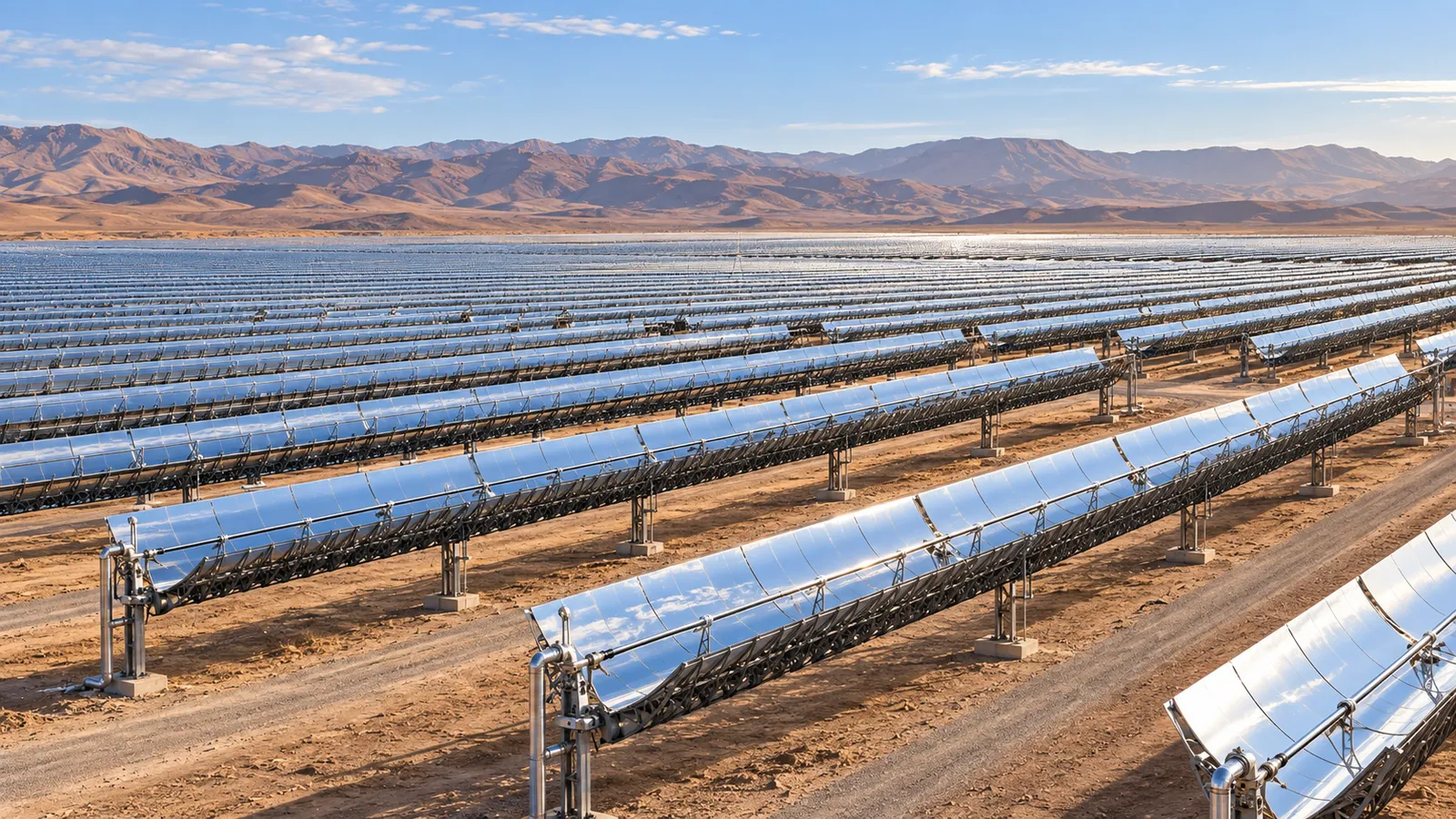
Generated contextual illustration; it does not depict the announced site or project.
What the decision changes
Morocco’s Official Gazette of 20 November 2025 publishes two decrees approving state guarantees for European Investment Bank loans to MASEN for Noor Midelt: €190 million and €197 million. Together, they are equivalent to approximately MAD 4.15 billion at the 20 November exchange rate.
These guarantees back repayment commitments to the lender. They are not an announcement of new cash received: the EIB dates both loan signatures to 21 December 2018. For Tranche A, €190m replaces a €119m guarantee approved in 2020; those two amounts must not be added together.
The idea explained
Who guarantees, who lends, and for what purpose?
Two loans signed in 2018, covered by guarantees published in 2025. Arrows do not represent observed disbursements.
Documented purpose: construction and operation of the Noor Midelt programme’s plants.
What are the loans intended to support?
The EIB links its loans to building and operating two hybrid plants near Midelt, combining photovoltaics, concentrated solar thermal generation and storage. The project therefore concerns electricity for the grid, extending its intended reach beyond Midelt itself.
Photovoltaics turn light directly into electricity. The thermal component concentrates sunlight to produce heat; some can be stored and later used to generate electricity after sunset. This is the historical principle illustrated here; the guarantees do not confirm a final configuration.
How much electricity, and who would benefit?
In its scenario approved in 2017, the African Development Bank envisaged two plants totalling 800 MW and producing a combined 1,886 GWh a year. This annual volume is a historical project forecast, not measured production or additional output purchased by the loans guaranteed in 2025.
To convey the scale, the AfDB compared that output with the annual electricity consumption of more than 2 million people, using 900 kWh per person in 2015. This reference is expressed in people, not connected households: it is not a commitment to supply a particular set of homes.
The electricity was intended for the national grid, used by households and productive activities including industry and agriculture. The aim was to improve electricity availability and reduce reliance on imported fossil fuels.
The intended impact: solar electricity available later
For users, storage aims to make some solar generation available when demand continues into the evening. This explains the project’s intended value beyond its stated capacity: the time at which electricity is delivered also matters.
Local effects also need concrete attention. The EIB assessment records employment, land-access and water-use issues raised during local consultation. An energy forecast therefore does not, by itself, demonstrate jobs actually created or lower electricity bills.
The idea explained
Solar energy can also serve after sunset
Hybrid principle described by the EIB in 2018–2022, illustrated without a site layout. Midelt’s final configuration is not confirmed here.
During sunny hours
Two complementary routes: generate directly with photovoltaics and retain heat in the thermal part.
After sunset
Retained heat can support electricity generation when sunlight is no longer available.
What still has to be delivered
Those earlier targets must be read alongside subsequent developments. The World Bank reports that, when its financing closed in June 2024, construction of the two plants had not started and the thermal component remained under discussion.
The November 2025 decrees give neither a new commissioning schedule nor an updated generation forecast. They support financing; the final configuration and its delivery will determine the electricity actually supplied and the benefits achieved.
