Solar Technology Atlas
    Technology sheet · Solar panels

    Monocrystalline Solar Panels What matters before buying

    Mono panels are the mainstream rigid silicon modules many quotes start with. This sheet places mono in the panel family, explains why it became common, shows how price should be read, and points to the study details that make the proposed model credible for a real site.

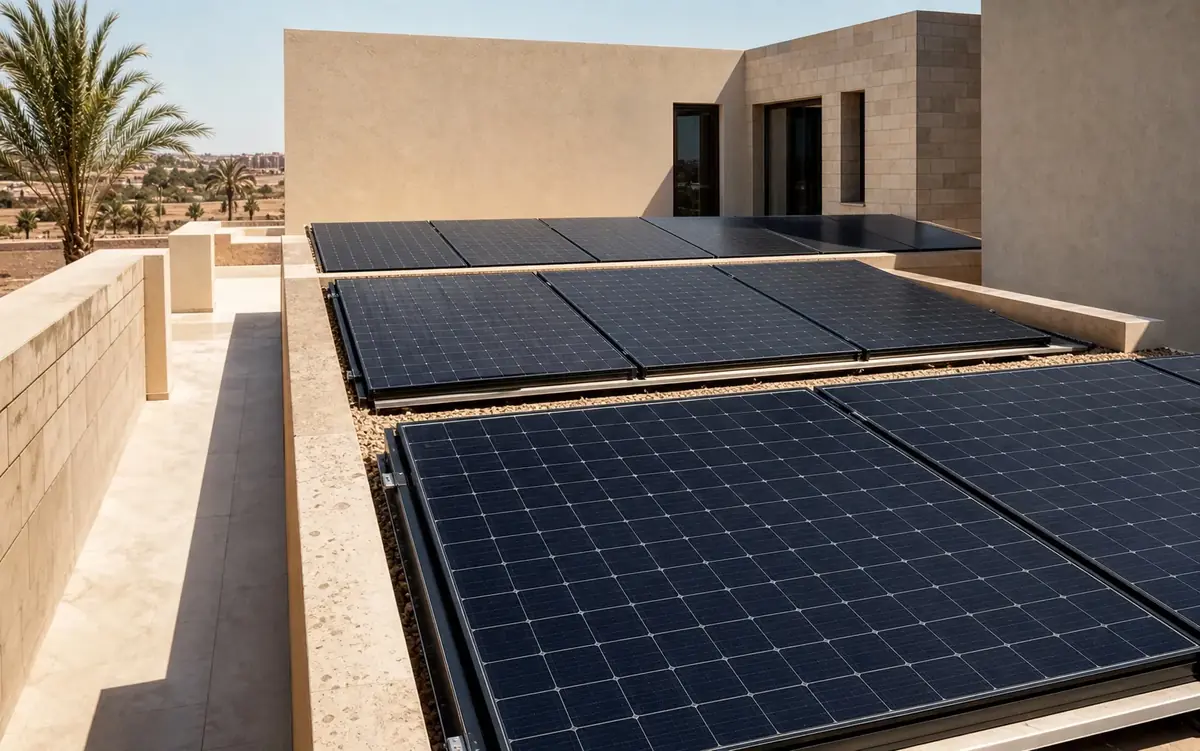
    Dark monocrystalline solar modules installed on a Moroccan roof terrace with visible module scale and mounting access
    Recognition view: dark framed mono modules, real surface fit, roof edges and access space.
    01 · What mono means

    Mono is a cell family. The module model is the product.

    Monocrystalline silicon means the solar cells are cut from a single-crystal silicon structure. In practice, mono usually appears as a dark, rigid framed module used on roofs, carports and ground-mounted systems.

    The word mono names the cell family. The exact model carries the real product details: dimensions, rated power, efficiency, temperature behavior, warranty terms, support path and whether it fits the study.

    02 · Why mono became common

    Mono became the normal panel family because it solved ordinary project problems.

    The modern silicon solar cell dates back to Bell Labs in 1954, which places mono inside a mature product family rather than a passing sales label. What changed over decades is manufacturing scale, efficiency, cost and the module formats installers can specify with clear documents.

    That maturity matters in a quote. Mono usually gives useful power density in a standard rigid panel format, which helps when a roof, terrace, carport or ground structure has limited usable area.

    It also gives the project a clearer paper trail: model names, datasheets, warranty documents, serial records and replacement logic. Those details are the bridge from a familiar technology word to a panel that can actually be checked.

    Maturity context

    DOE describes monocrystalline silicon as the dominant absorber material in current shipments. Modern labels such as PERC, TOPCon, HJT and half-cut usually sit inside the same mono product conversation.

    Useful power density

    DOE describes monocrystalline panels as more efficient than polycrystalline panels. That matters when the available surface is limited and each square meter has to work harder.

    A standard rigid format

    Mono panels fit the normal rooftop, carport and ground-mount design language: framed modules, mounting rails, datasheets, warranties and replacement paths.

    A mature supported product family

    Because mono is now mainstream, quotes can usually be checked against clear model names, manufacturer documents and support routes instead of vague product descriptions.

    Source: DOE PV Cells 101

    03 · What the module model changes

    The model is where mono becomes a real project choice.

    Once mono is understood as a mature family, the useful question becomes narrower: which exact module is being proposed, and what does that model change on this site?

    The model carries the dimensions, wattage, efficiency, heat behavior, weight, warranty terms and support route. A mainstream mono module and a premium mono line can both be sensible, but only when the study shows what the difference changes.

    Price belongs in that same reading. Exact local prices age quickly, but the quote can still show whether a premium model is buying more density, better warranty language, stronger availability, a better layout, or simply a more expensive name.

    Module-model ledger

    Cost context belongs beside the model record. The useful comparison is what a module line changes after the datasheet, layout and support path are visible.

    Mainstream mono

    Normal current module family
    Read it as

    Mono is now the familiar center of many panel quotes: efficient, widely available and easy to document against a current datasheet.

    Study must show

    The study still needs to show the exact model, usable surface, module count, warranty document and support route.

    Premium mono line

    Higher-cost product argument
    Read it as

    N-type, TOPCon, HJT, bifacial or glass-glass language can point to a more expensive product line, depending on brand, warranty and availability.

    Study must show

    The quote should explain whether the premium improves density, warranty confidence, modeled output, durability or replacement support.

    Study justification

    Where price becomes project value
    Read it as

    A lower module price or a premium module name is incomplete until the project layout, heat behavior, inverter path and support trail are visible.

    Study must show

    Compare final fit, modeled production, handover documents and replacement path before treating module price as the decision.

    04 · Names on the panel line

    Let the label lead back to the exact module.

    Mono, PERC, TOPCon, HJT, half-cut and wattage can appear together on a quote. Each label should point back to the model, datasheet, study assumptions and support route.

    MonoRead
    Seen as

    Mono, monocrystalline, mono-crystalline

    The cells are made from a single-crystal silicon structure. On a quote, this usually means a standard rigid panel family rather than a niche product.

    Treat mono as the family name. The exact module model is what lets the datasheet, warranty and support route be checked.

    PERC / TOPCon / HJTRead
    Seen as

    Mono PERC, N-type TOPCon, HJT module

    These are cell-architecture labels inside modern mono product lines. They describe how the cell is built to use light and control losses.

    Use the label as a prompt to compare efficiency, temperature behavior, warranty language and availability before turning the acronym into a buying reason.

    Half-cutRead
    Seen as

    Half-cell, half-cut cell, 120 / 132 / 144 cells

    The internal cell layout is split into smaller sections. The buying relevance is mostly about how the chosen module behaves in the full layout.

    Look for shade, module layout and inverter or MPPT compatibility being treated together. Internal circuit detail stays with qualified design.

    WattageRead
    Seen as

    450 W, 500 W, 550 W module

    Wattage is the rated output of one module under standard test conditions. Final project size comes from wattage, dimensions, surface fit and layout constraints together.

    Read wattage with module dimensions, usable surface, heat, shade, mounting and inverter or MPPT match.

    05 · Model details that change the study

    Datasheet numbers earn attention when they change fit, value or support.

    A datasheet number becomes useful when it changes surface fit, rated power density, hot-roof behavior or warranty responsibility.

    This is where the mono/poly hot-climate shortcut can mislead. Heat behavior belongs to the specific module, mounting condition and production model.

    W
    Rated power
    Details
    Where it appears

    Product page, datasheet, quote line

    What it changes

    Starts the module comparison, then needs module count and site model.

    A useful number that still needs the final system context.

    m2
    Module dimensions
    Details
    Where it appears

    Datasheet mechanical data

    What it changes

    Turns the product into a layout question: how many modules fit the usable surface?

    Important when roof area, access zones or obstacles limit count.

    W/m2
    Roof density
    Details
    Where it appears

    Calculated from wattage and area

    What it changes

    Shows how much rated power fits in each square meter before site losses are modeled.

    Useful for surface-constrained projects before the full production estimate.

    %/deg C
    Temperature coefficient
    Details
    Where it appears

    Datasheet electrical data

    Source: HOMER PV temperature coefficient explanation

    What it changes

    The provider should account for heat behavior in the production estimate, especially on hot roofs.

    Hot-climate performance comes from the exact model, mounting and production model.

    Years
    Product and performance warranty
    Details
    Where it appears

    Warranty document

    What it changes

    Separates product defects from output promises, exclusions and support route.

    A warranty is only useful when the model, serial trail and local support path are clear.

    06 · Surface fit example

    Higher wattage still has to fit the surface.

    A 550 W module can absolutely be the better option when it fits cleanly and gives more project capacity, fewer modules for the same target, or a cleaner structure.

    A smaller module can also make sense when the larger format loses count around obstacles, access zones, shade or mounting constraints. This is the practical reason the previous numbers have to be read together instead of separately.

    Roof-layout ledger

    The same wattage claim changes once the roof count is written down.

    This is the simple proof the section needs: count the modules that actually fit, then compare total kWp with access, shade and support constraints in view.

    01

    Clean rectangular surface

    Same usable roof strip
    550 WCount that fits: 8
    550 W × 8 = 4.4 kWp
    450 WCount that fits: 8
    450 W × 8 = 3.6 kWp

    The 550 W module can lead when its larger format fits cleanly.

    02

    Interrupted surface

    Same usable roof stripFixed obstruction
    550 WCount that fits: 6
    550 W × 6 = 3.3 kWp
    450 WCount that fits: 8
    450 W × 8 = 3.6 kWp

    The smaller module can lead when the larger format loses count around the roof.

    Illustrative module envelopes and roof strip, not a site layout. Exact dimensions, setbacks, access and shade must come from the selected datasheets and site survey.Next proof to ask for: A layout that shows usable surface, obstacles, access paths, shade zones and the resulting module count.
    07 · Study proof

    The proposal should make the module choice visible.

    After the model and surface logic are clear, the proposal should connect them to the actual site: usable area, heat, shade, inverter path, warranty documents and replacement support.

    Study visibility

    Surface and layout

    A credible proposal makes the usable surface visible before panel count or system size becomes convincing.

    Module count after obstacles and access paths
    Roof, carport, terrace or ground-mount fit
    Shade zones and mounting constraints
    Study visibility

    Operating conditions

    The estimate should account for the conditions that turn a clean datasheet number into a real Moroccan site result.

    Heat behavior and mounting airflow
    Dust, shade and cleaning rhythm
    Loss assumptions behind production
    Study visibility

    Electrical and support path

    The module choice should connect to system compatibility and to the support trail that remains after installation.

    Inverter or MPPT voltage/current window
    Why this module family was selected
    Warranty, serial trail and replacement route
    08 · Quote review

    Questions that keep the decision traceable.

    These questions keep the conversation practical. They ask the provider to explain the choice, the study and the support path in a way the buyer can follow.

    01

    What exact module model is proposed?

    The model name is the anchor for the current datasheet, warranty document and future replacement path.

    02

    Which mono line is it?

    Mono, mono PERC, TOPCon, HJT and half-cut labels should be clear enough to match the product page or datasheet.

    03

    Why was this panel selected for this site?

    The answer should connect to surface area, availability, warranty support, price, layout or another real constraint.

    04

    Has the study accounted for surface, heat, shade, dust and cleaning access?

    Those checks belong in the solar study. The reader is looking for evidence that they were considered, rather than a calculation task to carry alone.

    05

    Do the inverter or MPPT limits match the module string?

    Compatibility should be part of qualified design, especially when module voltage and current change between models.

    06

    What warranty and support route remain after installation?

    Product warranty, performance warranty, exclusions, serial records and local support should survive handover.

    Takeaway

    Mono is common for good reasons; the study shows whether this model fits.

    The strongest decision starts with the exact module model, why mono was selected, how the site was modeled, and what warranty and support trail remain after installation.

    Technology maturity explains why mono is common.

    The model choice and site study explain whether it belongs on the surface.

    Main misunderstanding

    The mono label should start a better comparison. The exact model, site conditions, cost position, support path and study assumptions finish it.

    SOLAR TECHNOLOGY

    Have a monocrystalline panel question?

    Send the product name, quote page or datasheet. ReneWave can explain what the module line means and which study assumptions should be visible before it shapes the final system.

    ReneWave markRENEWAVE

    Energy systems, held to standard.