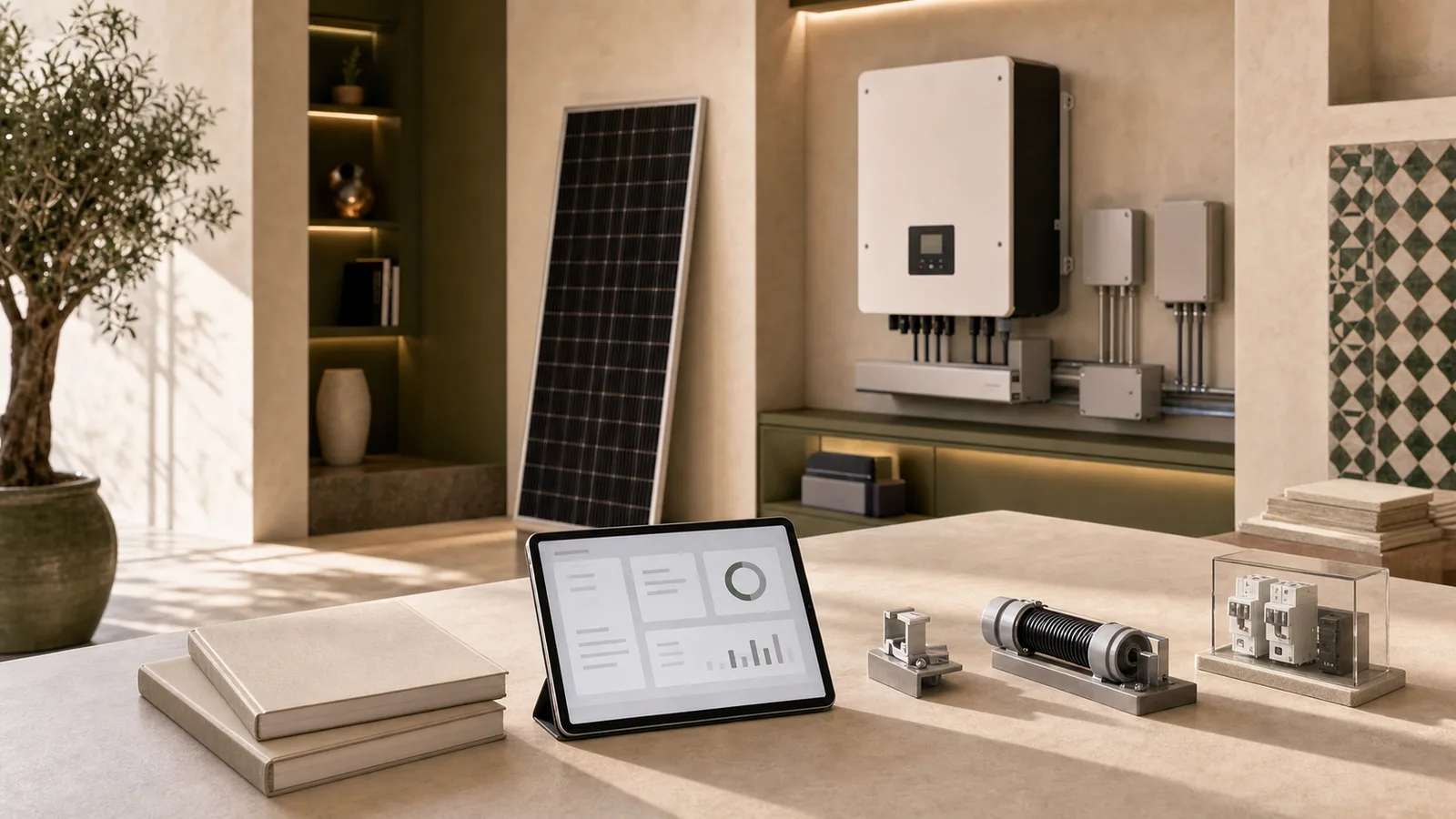
What the equipment section should prove.
The equipment section of a solar quote should do more than name products. It should help the buyer understand what is being installed, why it fits the site, how it will be monitored, what is covered by documents, and who supports it after installation.
In Morocco, many buyers compare quotes by panel brand, panel wattage, inverter size or a familiar manufacturer name. Those details matter, but they do not prove that the system is correctly matched to the roof, consumption pattern, architecture, backup objective or future support needs.
Solar panels: what to check without becoming technical.
A panel line should identify the actual model, quantity and rated power of the modules being proposed. Panel wattage describes the rated output of one panel under laboratory test conditions. It does not, by itself, tell you what the system will produce on your roof.
The practical reading is simple: do the panels fit the available roof area, shading constraints, access paths, mounting approach and production assumptions? A larger panel count can be useful when the site can use the production. It can also be a weak design if the layout ignores shade, maintenance access or self-consumption.
Panel power is a product detail. Roof fit is a project detail.
Buyer principle
The inverter defines how the system behaves.
The inverter converts solar production into usable electricity and often manages monitoring, grid interaction, battery connection, backup behavior and system protection logic. In a quote, the inverter line should therefore explain more than size and brand.
A buyer should understand whether the system is on-grid, hybrid, off-grid or another defined architecture. If backup is promised, the quote should explain the selected backup loads and the inverter's role in that behavior. If battery readiness is mentioned, the quote should explain what that readiness actually means.
A bigger inverter is not automatically a better inverter. The right inverter is the one that fits the objective, the PV array, the site's operating profile, the architecture and the support plan.
Solar Equipment Quote Decoder.
A useful quote makes the equipment line readable at a glance. It should show the actual products, the system role, the warranty documents and the support path without forcing the buyer to decode technical jargon.
Actual model, quantity, rating
Architecture and behavior
How performance is watched
Documents and support path
Shade, access, layout logic
What equipment line does not cover
The panel and inverter lines should explain how the system will behave on your roof, with your usage, under the architecture being proposed.
Compatibility matters more than a famous brand.
Solar equipment has to work as a system. Panels, inverter, batteries if included, monitoring platform, mounting approach and site constraints should support the same objective. A recognized product used in a poorly matched design can still produce a weak project.
Compatibility questions are practical: can the inverter support the proposed architecture? If batteries are included, are they intended for backup, evening use, autonomy or another defined purpose? Is monitoring supported? Are the proposed panels, inverter and future options aligned with the roof and consumption assumptions?
The quote should not push the buyer into technical design. It should show that the design team has checked compatibility before asking for approval.
Morocco site conditions should appear in the equipment logic.
Solar equipment is installed into a real environment. Heat, dust, rooftop exposure, shade from parapets or neighboring buildings, medina roof constraints, antennas, water tanks, HVAC equipment, access paths and technical-room ventilation can all affect how a system performs and how easy it is to maintain.
A quote that treats every roof the same may look clean, but it can hide practical problems. Equipment location matters. Monitoring access matters. Maintenance paths matter. A system that cannot be inspected or serviced easily can become harder to keep performing over time.
Equipment location should consider ventilation, access and rooftop conditions.
Panels should follow usable roof area, not just total roof area.
Layouts should leave room for inspection, cleaning and future service.
Warranties need documents, not only claims.
Warranty claims often sound reassuring in a quote. The buyer still needs the practical path: product model, warranty document, responsible installer or supplier, serial-number tracking after installation, commissioning record, and the process for support if something fails.
A long warranty line does not help much if nobody knows what exact product was installed, which document applies, who handles the claim, or how monitoring and maintenance records support the support process. Documentation is what turns warranty language into something usable later.
Monitoring and commissioning protect the equipment decision.
Monitoring is how the site sees whether the system is producing, communicating and behaving as expected after installation. A quote should state whether monitoring is included, who receives access, what the platform is used for and who responds when something is abnormal.
Commissioning is the handover moment where the installed system is checked, documented and made traceable. For the buyer, the important output is not a technical lecture. It is evidence: what was installed, how it was started, how monitoring is accessed, and what support path exists after the team leaves.
Battery readiness should not be used as marketing fog.
Some quotes describe a system as battery-ready. That can be useful, but it needs definition. Battery-ready does not mean backup is included. It does not mean every future battery will be compatible. It does not mean the site has already made a storage decision.
The quote should explain what future option is being preserved: selected backup, evening use, autonomy, critical-load support or another objective. If the site may add batteries later, the proposal should state what assumptions would need to be confirmed at that time.
Batteries should be discussed after the backup objective, load profile, critical loads, usable capacity logic and support requirements are clear.
Two quotes with similar equipment may still be different projects.
Two proposals can list similar panel brands and inverter brands while being built from different assumptions. One may include careful roof assessment, shade treatment, monitoring setup, commissioning, warranty registration and clear exclusions. Another may list the same equipment with weaker scope and less support.
This is why comparing equipment alone can mislead. The buyer should compare the full project: objective, architecture, production assumptions, self-consumption logic, roof fit, installation scope, monitoring, warranty path, after-sales support and exclusions.
System Fit Chain.
Equipment should follow the project logic. If the chain starts with product names instead of the site objective, the quote may be selling components before proving the design.
Bill reduction, backup, autonomy, pumping
On-grid, hybrid, off-grid, pumping
Roof fit and production assumptions
System behavior and monitoring
Visibility after installation
Warranty and maintenance path
Good equipment choices follow the objective, architecture and site assumptions.
What should be included around the equipment.
The equipment line should connect to the installation scope. A quote should make clear what is included around the panels and inverter: mounting system, monitoring setup, commissioning, documentation, warranty registration, handover, support, and any assumptions or exclusions that affect the equipment.
Exclusions are not automatically a problem. Roof repairs, waterproofing, structural work, electrical panel upgrades, network access, civil works, additional protection equipment, equipment relocation or technical-room improvements may reasonably sit outside a standard quote. The problem is when exclusions are not visible until after the project starts.
Weak equipment quote signs.
A weak equipment section is not always obvious. It may use professional language while still hiding the information needed for a decision.
- brand names with no model numbers;
- panel count without roof layout logic;
- inverter size with no architecture explanation;
- battery-ready language with no definition;
- monitoring not mentioned;
- warranty claims without documents;
- support responsibility unclear;
- exclusions hidden or missing;
- no commissioning or handover record;
- equipment comparison used instead of project comparison.
Questions to ask before approving the equipment line.
These questions do not require the buyer to become technical. They make the quote reveal whether the equipment has been selected as part of a real project.
- What exact panel and inverter models are being quoted?
- Why do these products fit this site's objective and architecture?
- How were roof area, shade, access and equipment location considered?
- What monitoring is included, and who receives access?
- What warranty documents apply, and who handles support?
- If battery-ready is mentioned, what future battery scenario is actually possible?
- What is included around the equipment: mounting, commissioning, handover and documentation?
- What is excluded and may need separate approval?
Warranty & Support Trail.
The best equipment choice can still become frustrating if the support trail is unclear. The quote should create traceability from the product line to future service.
What was actually installed
Terms and responsible party
Start condition and setup
Who can see performance
Who handles follow-up
What happens if support is needed
How ReneWave reviews solar equipment choices.
ReneWave reviews equipment from the site outward. We start with the objective, bills, operating rhythm, roof conditions, architecture and support needs. Only then do panels, inverters, batteries and monitoring become meaningful choices.
For Moroccan solar projects, we focus on self-consumption unless a specific export framework is confirmed. We check whether the equipment supports the proposed architecture, whether backup or battery language is clearly defined, whether roof constraints are visible, and whether the warranty and support path are documented.
The goal is not to make the quote longer. The goal is to make the equipment decision clear enough that the buyer understands what is being approved.
The key takeaway.
Solar equipment in a quote should be read through fit, not fame. Panels, inverters, batteries, monitoring and warranty claims only become useful when they are documented, compatible, supportable and matched to the site's objective, roof conditions and operating reality.
If the quote only gives product names and a price, the equipment decision is not ready yet.
Frequently asked questions.
Related guides & services.
Solar Guides
Browse ReneWave guides on solar sizing, batteries, quote review, pumping, and system architecture.
Open GuideHow to Read a Solar Quote
Architecture, sizing, battery purpose, production assumptions, payback scenarios, and exclusions before signing.
Open GuideReading a Solar Production Estimate
How to read kWp, kWh, monthly production, losses, shading, self-consumption and assumptions before trusting the output.
Open GuideOn-Grid, Hybrid, or Off-Grid Solar
How solar architecture should follow the site objective instead of sales terminology.
Open GuideBackup Power and Critical Loads
Define what should stay on during an outage before sizing batteries, inverters or hybrid systems.
Open GuideWhen Batteries Actually Make Sense
Battery purpose, backup circuits, usable capacity, autonomy, and when storage is worth discussing.
Open GuideSolar for Homes and Villas
Residential solar sizing, backup expectations, batteries, and quote review for Moroccan villas.
Open GuideSolar for Commercial Buildings
How offices, shops, clinics, warehouses and managed sites should evaluate solar before investing.
Open ServiceSolar Systems
ReneWave solar studies, design, installation, commissioning, monitoring setup, and support.
Open ContactRequest a Solar Study
Send your bills, roof information, objective, or current quote for engineering-led review.
Open