A bifacial module is built to use light from both sides.
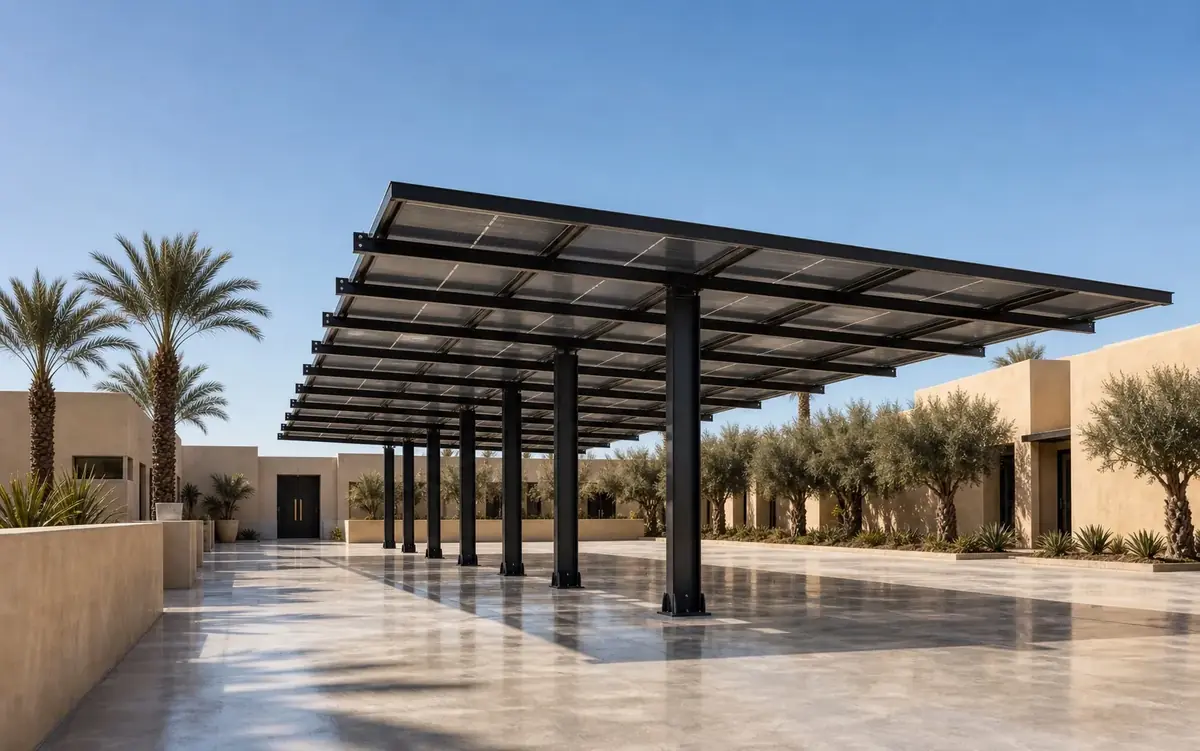
A bifacial solar panel is designed so light can reach active cell area from the front and from the rear. The front side still anchors the datasheet rating and the first comparison.
Rear-side contribution is usually a modeled gain. It depends on what the back of the module can see: surface reflectivity, rear clearance, tilt, spacing, dust, shading and the mounting structure.
The site decides whether the second face matters.
Bifacial value starts behind the module. A raised carport, pergola, canopy or ground mount can expose the rear side to reflected light in a way a dark flush roof usually cannot.
This is why the first serious question is physical: what surface sits below the panel, how much clearance exists, and what shadows or dust will interrupt the rear-side path?
Strongest fit
Bifacial is most convincing when the rear side has real exposure and the site surface can reflect useful light.
Depends on design
The useful rear contribution is earned by geometry, surface behavior and maintenance.
Weak fit
The value becomes thin when the back of the module is hidden or the study has no credible rear-side assumption.
It turns reflected light into a design question.
A normal front-side panel ignores most of the useful light that reaches the back of the module. Bifacial design makes that rear exposure part of the project conversation.
That is why the technology appears often in raised carports, ground mounts, canopies and utility-scale designs where spacing, ground surface and mounting height can be planned instead of guessed.
The idea has been around for decades: IEA PVPS traces the first patented bifacial solar cell design to 1960. Its project relevance grew later, as modern cell architectures, glass-glass construction and larger planned installations made rear-side collection easier to manufacture, model and specify.
That history matters only because it changes how the reader should judge the quote. Bifacial is a mature enough idea to take seriously, but the site still has to give the rear side a clear job.
It uses light behind the module
A conventional module focuses on the front face. Bifacial design gives the rear side a chance to convert reflected light into useful output.
It suits raised structures
Carports, canopies, pergolas and raised ground mounts can expose the rear side more naturally than a tight roof installation.
It pairs with modern module construction
Glass-glass and modern mono cell lines often appear in the same quote conversation because they support durability, rear exposure or premium positioning.
Source: IEA PVPS bifacial key topic
Bifacial belongs in the quote when the extra value is visible.
Exact local prices age quickly and rarely explain the project by themselves. The safer comparison is relative: standard mono is the baseline, bifacial mono is a premium/context-dependent choice, and optimized bifacial systems add structure or tracking logic.
The quote should make the extra value clear. It may come from modeled yield, a raised structure that was already needed, durability expectations, warranty support or a site surface that makes rear-side light credible.
The premium earns its place only when the rear light path is real.
Rear exposure
Raised mounting, open backs and careful row design give the rear side something to work with.
Reflective surface
Light-colored roofs, bright ground, canopy surfaces or controlled site finishes can strengthen the rear-side case.
Clearance and spacing
Height, tilt and row spacing decide whether reflected light reaches the module instead of being blocked by the structure.
Cleaning access
Dust, soiling and access plans matter because rear-side value can fade if the installation cannot be maintained.
Bifacial value becomes credible when reflected light, rear clearance, layout and maintenance are modeled together, then priced against the added module or structure scope.
Quote labels should lead back to the rear-side study.
Bifacial, bifaciality factor, glass-glass, N-type, TOPCon, HJT and front-side wattage can all appear together. The useful reading is simple: each label should help explain the exact model, the installation geometry or the study assumption.
BifacialRead
Bifacial module, bifacial solar panel, dual-sided module
The module is designed so light can reach active cell area from the front and rear sides.
Treat the word as a design feature. The study still has to show how much rear-side light the installation can actually use.
Bifaciality factorRead
Bifaciality, rear/front ratio, phi
A datasheet ratio comparing rear-side response with front-side response under test conditions.
Useful for modeling, and it still has to be read with albedo, mounting height, spacing, rear shading and layout review.
Glass-glass / dual glassRead
Dual glass, glass-glass, double-glass module
A module construction where glass is used on both sides instead of a conventional opaque backsheet.
Read it with weight, mounting method, warranty terms, handling and whether the rear side remains exposed.
N-type / TOPCon / HJTRead
N-type bifacial, TOPCon bifacial, HJT bifacial
Cell architecture labels often found inside modern bifacial mono product lines.
Use the label to compare datasheets, availability, warranty and price position rather than as a standalone reason to buy.
Front-side wattageRead
450 W, 550 W, 600 W front power
The printed module rating usually anchors the comparison from the front side.
Rear-side contribution should appear as a modeled gain assumption with visible site logic behind it.
