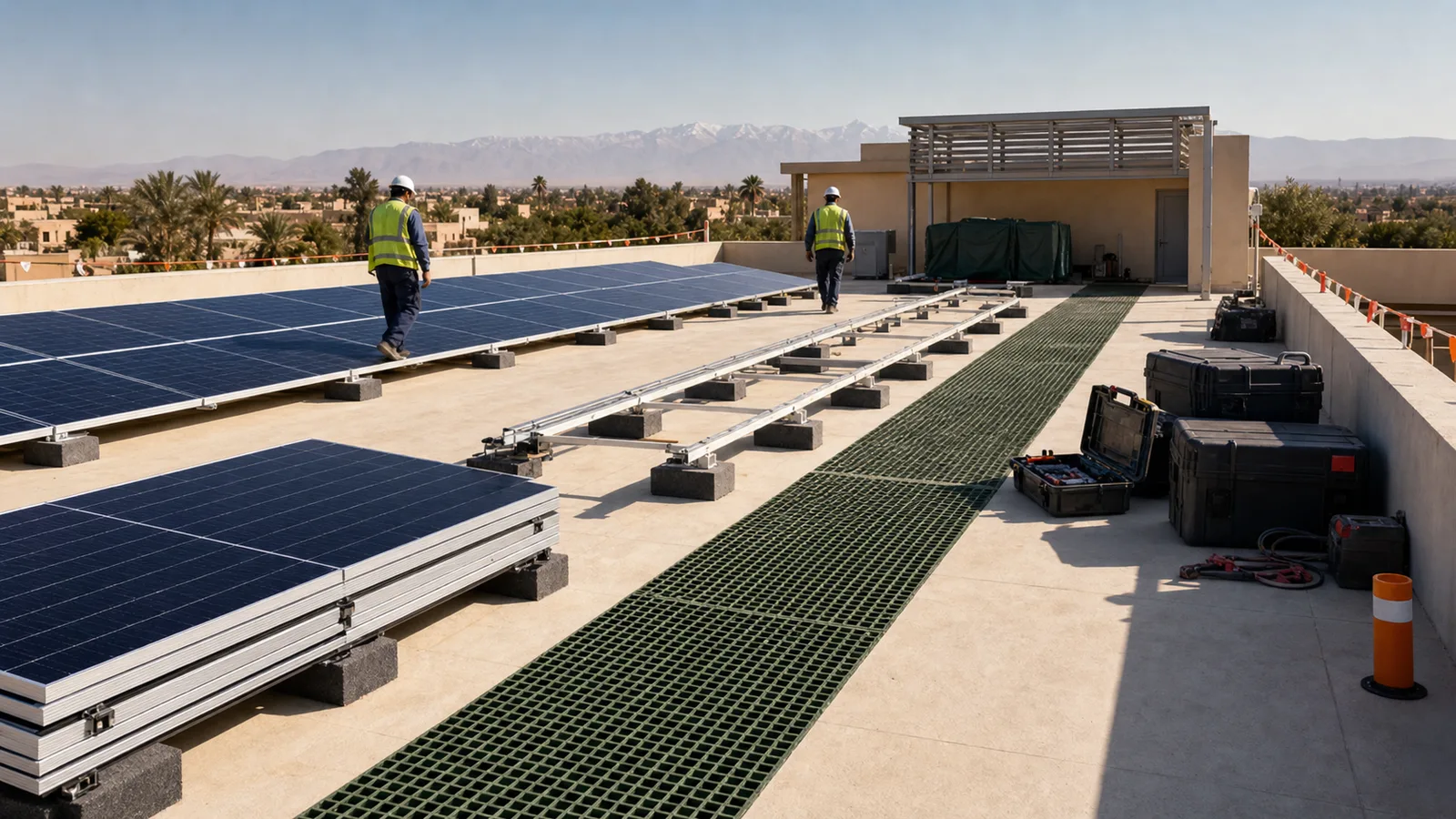
Installation quality decides what the design becomes.
A solar project can look strong on paper and still disappoint after installation. The system may produce less than expected, monitoring may be unclear, warranty support may be difficult, or maintenance may become slow because the installation was not built for access and traceability.
The installation stage is where assumptions become physical reality: panels are mounted, cable routes are chosen, equipment is placed, protection is verified, monitoring is activated and the site receives a technical record. Weak work at this stage can turn a good design into an operating problem.
Professional installation means the full system is controlled.
A professional installation is not measured only by whether the panels are straight. It should protect the building, the people, the equipment and the future maintenance record.
- Solar field. Panels and supports should fit the roof, avoid obvious shade conflicts and leave practical access.
- Protection logic. Isolation, surge exposure, labels, earthing and interface points should be verified by qualified personnel.
- Visibility. Monitoring should be active, accessible and connected to a support process.
- Technical memory. The site should receive records, photos and handover notes that make future support easier.
Site readiness should be confirmed before equipment arrives.
The first quality check happens before installation day. The site should be ready for the installation team, and the installation team should understand the site. Roof condition, access, shading, equipment location, technical-room constraints, internet or monitoring access and safety conditions all affect the final result.
For a villa, this may mean confirming roof waterproofing, parapet shading, inverter location and backup-load expectations. For a riad or hotel, it may mean coordinating guest areas, access times, rooftop circulation and equipment noise or visibility. For a farm or pumping system, it may include pump-room condition, exposure, distance and maintenance access.
Some confirmations belong to qualified personnel.
Owners should know what must be confirmed, but they should not be asked to verify electrical protection or earthing themselves. Electrical readiness, protection needs, isolation, earthing and equipotential bonding, AC interface points, DC-side safety, grid or backup interface and manufacturer requirements all require qualified review.
In the Moroccan market, TaqaPro is a useful quality context because it is presented as a national quality label for photovoltaic installers. It should be treated as one signal among others: a project still needs scope clarity, installation method, protection verification, commissioning and support. The CGEM decarbonation solar PV resource also frames photovoltaic installation as a professional technical field, not a casual rooftop product.
Useful references for buyer-level due diligence include the TaqaPro installer platform and the CGEM decarbonation solar PV page. The practical question is simple: which requirements, manufacturer instructions and verification records will the installer follow for this specific site?
Before / during / after installation map.
Installation quality is easier to judge when it is split into three moments. Each moment has a different job.
Before
site readiness, roof access, equipment location, protection needs
During
clean mounting, protected routes, safe work area, tidy technical space
After
commissioning, monitoring access, documents, support trail
During installation, clean work is an engineering signal.
A professional site should feel organized. Materials should not block unsafe paths, rooftop work should respect access and weather conditions, mounting should be aligned with the approved layout, equipment should be placed where it can breathe and be serviced, and cable routes should be protected rather than improvised.
This does not mean the owner supervises the crew technically. It means the owner can expect visible order: a known work area, clear responsibility, tidy routing, safe access and respect for the building. On hospitality or commercial sites, installation should also be coordinated around operating hours so the work does not create unnecessary disruption.
Protection and safety should be visible without becoming DIY.
Solar involves DC generation, inverter conversion, AC connection, rooftop exposure, surge risk, isolation, labeling, monitoring and sometimes batteries or backup circuits. These are professional topics. The owner should not receive instructions for how to wire, ground, size or modify the system.
What the owner should receive is clarity. The proposal and handover should say who is responsible for verifying isolation, surge protection where relevant, earthing and equipotential bonding, warning labels, equipment access, and the interface with the existing electrical installation. If a backup function is included, the protected loads and operating mode should be defined.
The buyer needs proof that protection was handled. The buyer does not need a repair manual.
Safety boundary
Protection and earthing verification map.
A useful protection discussion identifies the points that need professional verification. It should not draw a wiring path or tell the reader how to connect anything.
The owner receives proof of checks, not DIY instructions.
Different sites need different installation attention.
The same solar architecture can create different installation risks depending on the site. A villa may need careful discussion around roof waterproofing, aesthetics, inverter location and backup expectations. A riad or hotel may need guest-area coordination, rooftop access planning, hot-water or pump dependencies and quiet technical spaces.
A commercial building may need access control, rooftop equipment zones, tenant coordination and monitoring responsibility. A farm or pumping project may need exposure, distance, pump-room condition and water-storage logic. Industrial or warehouse sites may need stronger coordination around operating hours, roof load assumptions, access height and critical-load protection.
Before energizing, the system should be ready to operate.
Energizing a solar system should not feel like simply switching it on. Before operation, the responsible qualified team should confirm installation completion, protection devices, labeling, isolation, mounting, cable routes, inverter configuration, monitoring setup and any open items that still need closure.
If something remains uncertain, it should be written down. Open actions are not automatically a failure. Hidden open actions are the problem, because they leave the site believing the system is complete when it still needs follow-up.
Commissioning turns installation into a technical record.
Commissioning is the moment the installed system becomes traceable. It should confirm that the inverter is configured for the intended architecture, monitoring is active, the site can see production, photos are kept, the equipment list is recorded and the owner knows who to contact if something is abnormal.
For hybrid systems, commissioning should also confirm the backup objective at an owner level: which loads are protected, what operating mode is expected and what happens when the battery is depleted. For on-grid systems, the focus is production visibility, grid interface, monitoring and safe operation under the agreed scope.
Commissioning and handover trail.
The handover should create technical memory. Future support becomes easier when the first day of operation is documented properly.
Weak installation signs.
A weak installation process is often visible before the system is even energized. The signs are usually about missing ownership, missing verification or missing documentation.
Questions to ask before installation starts.
These questions are practical because they make the installer reveal process quality. They do not require the owner to become technical.
- What must be confirmed before installation starts?
- Where will panels, inverter, protection equipment and monitoring equipment be located?
- How will roof access, waterproofing risk and future maintenance paths be protected?
- Who verifies protection, isolation, earthing and equipotential bonding?
- What standards, manufacturer instructions or project requirements are being followed?
- What will be documented before the system is energized?
- Who receives monitoring access and who responds when something is abnormal?
- What photos, commissioning notes and warranty documents will be delivered?
How ReneWave manages installation quality.
ReneWave treats installation as the operational continuation of the design. We start with the site objective, roof reality, equipment choice and architecture. Then we confirm access, equipment location, protection responsibilities, monitoring, commissioning and handover before the work is treated as complete.
We keep safety-critical work with qualified personnel and keep the owner informed through scope, photos, records and clear support responsibility. The goal is a site that is visible, traceable and under control after the installation team leaves.
The key takeaway.
Frequently asked questions.
Related guides & services.
Solar Guides
Browse ReneWave guides on solar sizing, batteries, quote review, pumping and system architecture.
Open GuideHow to Read a Solar Quote
Architecture, sizing, batteries, production assumptions, payback, warranties and exclusions before signing.
Open GuideSolar Equipment in a Quote
How to review panels, inverters, compatibility, monitoring, warranties and support beyond brand names.
Open GuideBackup Power and Critical Loads
Define what should stay powered during an outage before sizing batteries or hybrid systems.
Open GuideReading a Solar Production Estimate
How production assumptions, losses, shading and self-consumption affect solar decisions.
Open GuideOn-Grid, Hybrid, or Off-Grid Solar
How solar architecture should follow the site objective instead of sales terminology.
Open ServiceSolar Systems
ReneWave solar studies, design, installation, commissioning, monitoring setup and support.
Open ContactRequest a Solar Study
Send your bills, roof information, objective or current quote for engineering-led review.
Open