Published by ReneWave 10/09/2026
ReneWave · News · Morocco
Synhelion announces agreement for a Tan-Tan fuel plant
On September 8, 2026, Synhelion announced a memorandum of understanding with the Moroccan government to develop a synthetic-fuel plant in Tan-Tan, targeting 100,000 tonnes a year.
ReneWave
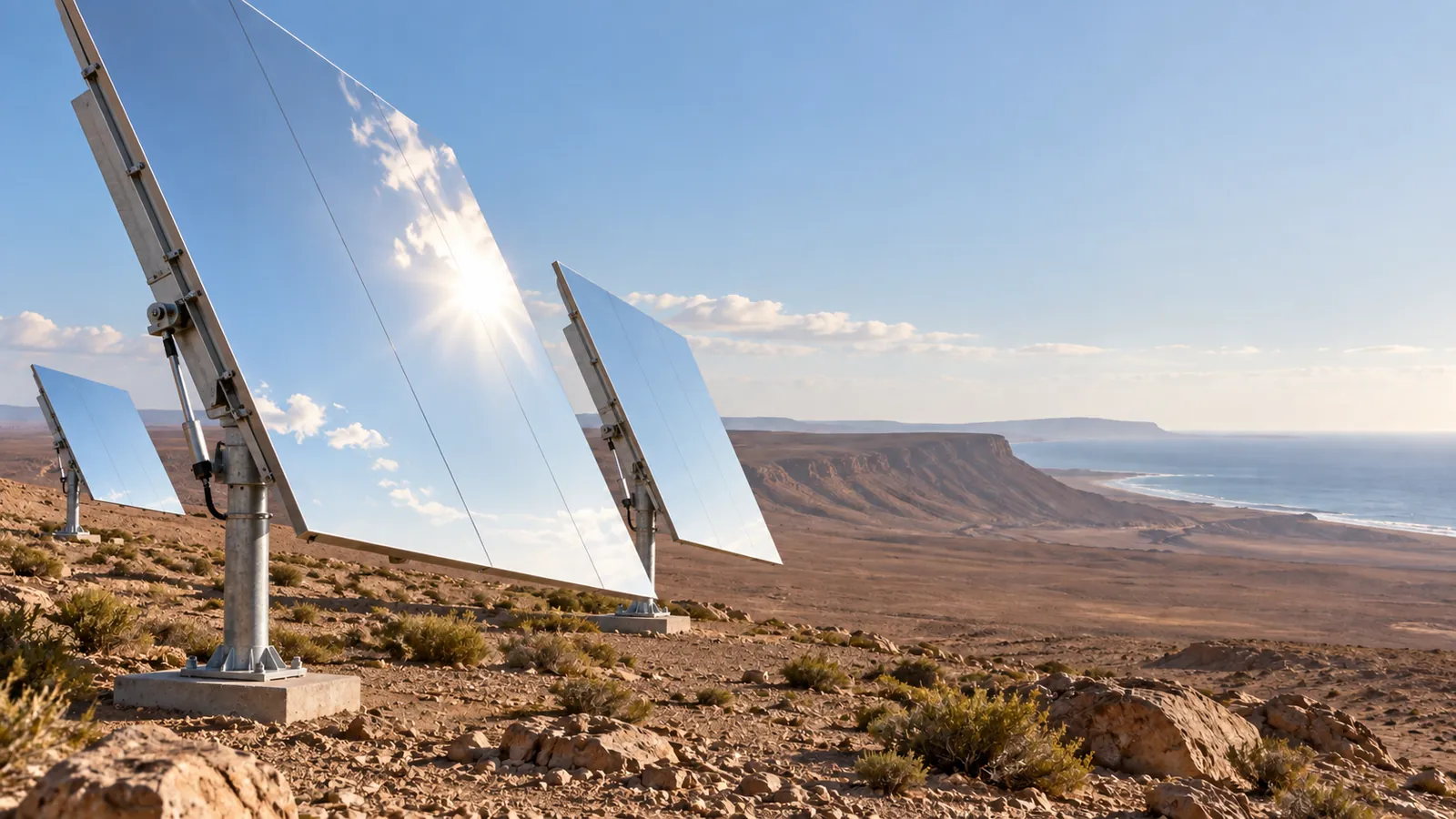
Generated contextual illustration; it does not depict the announced site or project.
- Target annual output
- 100,000 tonnes of fuelAnnounced target
Planned capacity announced by Synhelion; not output already achieved.
- Project stage
- Memorandum of understandingAnnouncement
Land reserved and Moroccan branch established, according to the company.
An agreement, with further milestones to clarify
The proposed site is in Tan-Tan province, in the Guelmim-Oued Noun region. The agreement involves the ministries responsible for industry, energy transition and investment, alongside AMDIE. For Morocco’s energy and transport sectors, the announcement concerns a potential new industrial use for renewable resources.
How much investment, and when? The September 8 release gives no budget, construction start or commissioning date. Le Desk recalls a one-billion-dollar amount mentioned in 2025 during initial contacts. That earlier figure is not confirmed as the current project budget.
Fuel for transport
The 100,000-tonne annual target concerns transport fuels. It gives a sense of the industrial project’s intended scale, while remaining conditional on delivery rather than representing measured production.
Synhelion presents its technology as a route to synthetic jet fuel, diesel and gasoline. Its appeal for users is the potential to replace fossil fuels in transport. The company’s press kit describes fuels compatible with existing engines and infrastructure, particularly for uses that are difficult to electrify. This manufacturer description does not specify the future product mix at Tan-Tan.
How energy becomes fuel
The process Synhelion currently describes combines biogas and water with process heat above 1,200°C. Conversion produces an intermediate gas, which is then turned into liquid fuels. The diagram below summarises these steps: it explains the manufacturer’s technology, rather than an approved engineering plan for Tan-Tan.
To supply the heat, Synhelion describes two options: renewable electricity, or mirrors concentrating sunlight onto a receiver. Photovoltaic panels produce electricity; mirrors redirect light to provide heat. These different functions do not establish that one solution has been selected over the other at Tan-Tan. The final configuration remains to be clarified.
How the process works
From feedstock and heat to fuel
Conceptual diagram of Synhelion’s process. Tan-Tan’s final configuration is not confirmed.
Two complementary inputs
- Biogas + water
Certified biogenic waste becomes biogas: methane and CO₂.
- Renewable heat
Renewable electricity OR concentrated sunlight; the process can include thermal storage.
- 01Conversion
Heat enables the reactor to transform biogas and water.
- 02Synthesis gas
A mixture of hydrogen (H₂) and carbon monoxide (CO).
- 03Liquid fuels
Industrial synthesis leads to jet fuel, diesel or gasoline.
