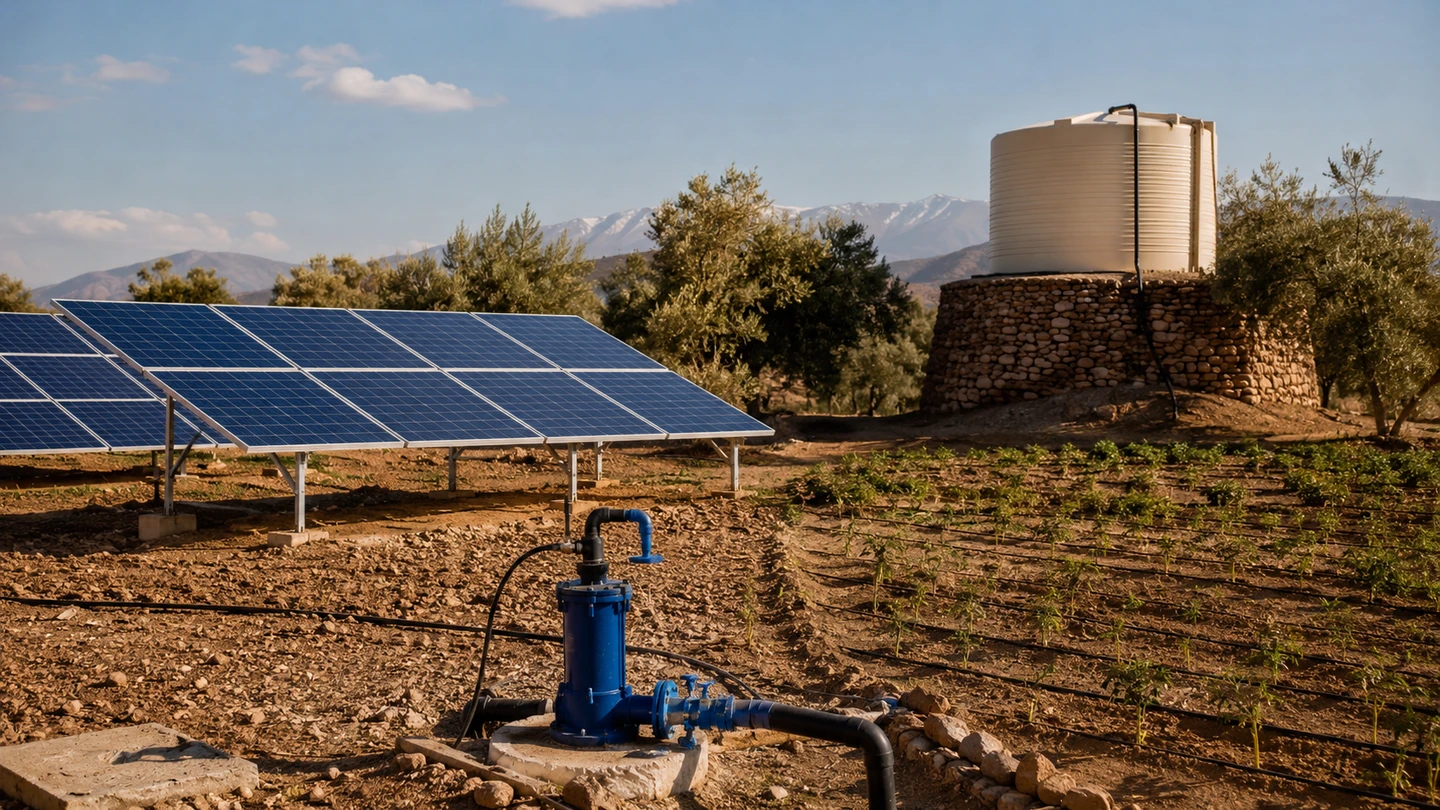
Solar pumping starts with water demand, not panels.
A serious solar pumping design does not start with the number of panels. It starts with the water requirement.
That means understanding how much water the site needs per day, when that water is needed, and whether the demand is constant, seasonal, or occasional.
A farm with drip irrigation has a different water profile from a villa garden. A borehole filling a storage tank has a different profile from a pump that must maintain pressure directly. A remote livestock site has a different profile from a commercial property with landscaping and domestic water use.
The pump is selected to meet the water duty. The solar system is selected to operate the pump. The storage strategy is selected to make the water available when needed.
This order matters. If the project starts with a panel count instead of a water requirement, the result may be oversized, undersized, unreliable, or unnecessarily expensive.
- Daily volume
- Seasonal demand
- Use case
- Well / borehole
- Tank / reservoir
- Available flow
- Lift
- Flow
- Pressure
- Pipe route
- Direct use
- Water tank
- Battery only if justified
- Direct solar
- Grid-supported
- Generator-supported
- Battery-supported
Panel count is an output, not the starting point.
Conceptual decision map only — final design depends on site-specific water and solar review.
What solar pumping can do.
Solar pumping can be useful when the energy demand of the pump aligns with sunlight or when water can be stored after pumping.
In a well-designed system, solar panels produce energy during the day. That energy powers a pump that moves water from a well, borehole, reservoir, tank, or other source. The water may be used directly or stored in an elevated or ground-level tank for later use.
This is why solar pumping can be efficient: instead of storing electricity in batteries, the system can often store water. The panels work during the day, the pump fills the tank, and the site uses the water when needed.
Solar pumping changes the energy source and operating cost of moving water. It does not change water rights, extraction limits, source capacity, or the site owner’s responsibilities regarding water use.
Solar pumping works best when the water logic and solar logic are designed together.
Engineering principle
When solar pumping makes sense.
Solar pumping is often a strong option when at least one of the following conditions is true.
The site needs water mostly during daylight
If pumping is needed mainly during the day, solar production and water demand can align naturally. This is common in irrigation, tank filling, garden watering, and some agricultural uses. The pump can operate during strong solar hours, reducing reliance on the grid or generator. The more flexible the pumping schedule, the easier the solar design becomes.
Water can be stored
Water storage changes the economics and reliability of solar pumping. If the system can pump into a tank during the day, the site can use that stored water later without needing the pump to run at night. In many pumping projects, this is better than storing electricity in batteries. A storage tank can make the system simpler, cheaper, and more robust than a battery-based design. The tank becomes the buffer. The solar system does not need to run the pump every time water is needed. It only needs to fill storage when solar production is available.
The site is remote or poorly served by the grid
Solar pumping can make sense for remote farms, rural plots, wells, boreholes, isolated homes, gardens, and livestock points where bringing grid power is expensive or impractical. In these projects, the solar pumping system is not only a cost-saving tool. It may be the practical way to make water available. However, remote sites also require more discipline. Access, theft protection, maintenance, spare parts, and monitoring become more important because failures may take longer to detect and repair.
Diesel pumping is expensive or inconvenient
Where diesel generators are used for pumping, solar can reduce fuel use, transport, maintenance, noise, and operating effort. But the comparison must be honest. A solar pumping system has upfront cost, equipment risk, cleaning needs, controls, protection requirements, and maintenance requirements. It should not be sold as if it has no operating cost or no design limits. The serious comparison is not solar versus diesel in emotion. It is solar versus diesel in total operating reality: fuel, maintenance, reliability, supervision, water output, and long-term support.
The pump schedule is predictable
Solar pumping becomes easier when the water demand is predictable. A site that needs a known daily volume can be sized more confidently than a site where the owner is unsure how much water is needed. A predictable irrigation schedule, tank-filling requirement, or livestock demand gives the designer a clearer basis. Unclear demand leads to unclear sizing.
When solar pumping may not be the right answer.
Solar pumping is not always the best solution. Sometimes the better answer is grid pumping, diesel backup, a larger water tank, changing the irrigation schedule, repairing an inefficient pump, reducing water losses, or redesigning how water is distributed.
Solar pumping may not be appropriate when the water requirement is mostly at night and no water storage exists. In that case, the project either needs batteries, generator support, grid support, or a different operating strategy. Batteries may be justified in some cases, but they add cost and replacement obligations.
Solar pumping may also be weak when the water source is uncertain. If the well or borehole cannot deliver the required flow, adding solar power will not solve the water problem. The pump cannot reliably deliver water that the source cannot provide.
It may also be inappropriate when pressure requirements are high or variable and the system is expected to serve direct pressurization without a proper hydraulic design. Solar energy can power a pump, but it does not automatically solve pressure regulation, pipe losses, pump cycling, or distribution problems.
It may be risky when the owner wants the cheapest possible system but also expects reliable water during all conditions. Water reliability requires proper sizing, protection, controls, storage logic, and maintenance.
And it may be poor economics when pumping is very occasional. If a pump only runs rarely, the cost of a dedicated solar pumping system may not be justified.
The honest test is simple: does the site have enough regular pumping demand to justify a dedicated solar solution? If not, another approach may be better.
The best storage is often water storage, not batteries.
Many buyers immediately ask whether solar pumping needs batteries. In many cases, the answer is no.
For pumping projects, the best storage is often not electrical storage. It is water storage. A solar pumping system can run during the day and fill a tank. The site then uses water from that tank when needed. This avoids the cost, complexity, efficiency losses, and future replacement of batteries.
This is especially relevant when the water does not need to be pressurized directly from the pump at all times.
Water tanks are not free. They require space, structure, plumbing, level control, overflow planning, hygiene considerations where relevant, and maintenance. But for many pumping projects, they are still a better buffer than batteries.
Batteries become more relevant when:
- pumping must happen outside solar hours;
- water storage is impossible or insufficient;
- pressure must be maintained continuously;
- the site has other electrical loads that also need backup;
- operational continuity matters more than simple cost optimization.
Even then, the battery should have a defined job. It should not be added automatically.
- Stores the result: water
- Often simpler for pumping
- Useful for daylight pumping
- Reduces need for batteries
- Stores electricity
- Adds cost and replacement
- Useful only when justified
- Needed for specific operating cases
Conceptual comparison only — actual storage choice depends on water demand, site constraints, and operating requirements.
Direct, grid-supported, generator-supported, or hybrid pumping?
Solar pumping can be configured in different ways. The right configuration depends on the site.
Direct solar pumping
In a direct solar pumping setup, the pump runs when solar energy is available. The system is usually simplest when water can be stored in a tank during the day. This can be effective for irrigation, tank filling, and remote sites with flexible water demand. The limitation is clear: when sunlight is weak or absent, pumping capacity drops or stops unless another energy source is available.
Grid-supported solar pumping
If the site has grid access, the pump may be designed so solar reduces grid consumption while the grid remains available when solar production is insufficient. This can be useful when pumping reliability matters and the grid is reasonably available. The design should clearly explain how the pump uses solar, how grid fallback works, and whether the economics justify the configuration.
Generator-supported solar pumping
For remote sites, a generator may remain as backup for cloudy periods, high water demand, or emergency operation. This does not mean the solar system has failed. In some off-grid pumping projects, generator support is a practical reliability layer. The proposal should explain when the generator is expected to run and what assumptions are being made.
Battery-supported pumping
Battery-supported pumping is possible, but it should be justified carefully. A battery may be useful when water demand is outside solar hours, when the site has no practical water storage, or when the pump is part of a broader hybrid system serving other loads. But for many pumping projects, batteries are not the first storage option. A water tank is usually the first question.
Pump runs when solar production is available.
Daytime pumping and tank filling.
Solar reduces grid consumption while grid remains available.
Sites with grid access and reliability needs.
Solar handles normal operation; generator supports exceptions.
Remote sites needing fallback.
Battery powers pumping outside solar hours when justified.
Night pumping, no water storage, or broader hybrid needs.
Conceptual architecture overview only — actual configuration depends on site-specific review.
The sizing questions that matter.
Solar pumping sizing depends on more than pump power. A serious design should consider:
- daily water requirement;
- water source type;
- water source depth;
- static water level and dynamic water level where known;
- total lift height;
- pipe length and friction losses;
- required flow rate;
- pressure requirement;
- pump type;
- irrigation schedule;
- seasonal water demand;
- available solar window;
- storage tank capacity;
- grid or generator fallback;
- operating environment;
- access for maintenance.
The buyer does not need to become a pump engineer. But the buyer should understand that a solar pumping quote cannot be serious if it ignores these inputs. A proposal that only says “solar pump system” with panel quantity and pump power is not enough. A proposal should explain what water duty the system is designed to meet.
What a serious solar pumping proposal should explain.
A serious solar pumping proposal should make the assumptions visible. It should explain:
- the water demand used for sizing;
- the source of water;
- the pump duty;
- the assumed pumping hours;
- the required flow and pressure logic;
- the selected pump type;
- the selected solar array size;
- whether the system is direct solar, grid-supported, generator-supported, or battery-supported;
- whether water storage is included or assumed;
- what happens during weak solar conditions;
- what protections and controls are included conceptually;
- what is included in installation scope;
- what is excluded;
- what monitoring or follow-up is included;
- what maintenance is recommended;
- what assumptions still need to be verified on site.
For complex projects, some details may be preliminary until a site visit or Solar Pumping Assessment is completed. That is acceptable when the proposal clearly states what remains to be verified. What is not acceptable is a quote that pretends a pumping problem has been solved without defining the water problem.
- Daily volume
- Schedule
- Seasonality
- Pressure need
- Source type
- Depth
- Available flow
- Water level
- Pipe route
- Lift height
- Tank location
- Access
- Direct solar
- Water storage
- Fallback
- Battery if justified
Conceptual quote-review guide only — final sizing requires site-specific water and solar information.
Common signs of a weak solar pumping quote.
Be careful when a quote:
- starts with panel quantity before water demand;
- does not ask how much water is needed per day;
- does not ask when water is needed;
- ignores well or borehole conditions;
- does not discuss water storage;
- adds batteries without explaining why;
- promises reliable pumping without fallback logic;
- does not clarify pump type;
- does not mention flow, lift, pressure, or pipe route assumptions;
- does not explain what happens during cloudy periods;
- does not clarify installation scope and exclusions;
- does not mention commissioning or post-installation support.
A weak quote may still include recognizable brands and a polished layout. That does not make it an engineered pumping solution.
Solar pumping is not only about reducing cost.
Many buyers think of solar pumping only as a way to reduce electricity or diesel cost. That is one benefit. But the value of solar pumping can also be operational.
A remote site may value access to water more than financial payback. A farm may value predictable tank filling during the day. A property owner may value reducing generator use. A hotel or riad with gardens may value a cleaner and more controlled pumping setup. A rural plot may value simplicity.
These reasons can be valid. But they should be made explicit. If the purpose is cost reduction, the financial scenario should show the assumptions. If the purpose is water access, the design should show expected water delivery. If the purpose is reliability, the design should show storage and fallback logic.
A solar pumping system should not be sold with vague promises. It should be sold with a clear purpose.
ReneWave Engineering
What a good solar pumping system should leave you understanding.
After reading a serious proposal, you should understand:
- how much water the system is designed to move;
- when the pump is expected to operate;
- what water source is being used;
- whether water storage is part of the strategy;
- whether batteries are included and why;
- whether grid or generator fallback exists;
- what happens during weak solar production;
- what equipment is included;
- what work is excluded;
- what support exists after installation.
The system does not need to be overcomplicated. But it needs to be designed around water reality. If the proposal only gives you a pump, panels, and a price, you do not yet have enough information to sign.
Solar Pumping Project Checklist.
Use this checklist before accepting a solar pumping proposal.
Common mistakes in solar pumping projects.
Starting with panels instead of water demand.
The number of panels should come after the water requirement is understood. Otherwise, the system may not match the real duty.
Ignoring water storage.
A tank can often do the job that buyers assume batteries must do. In many pumping projects, water storage is simpler than electrical storage.
Adding batteries by default.
Batteries are sometimes useful, but they should not be automatic. They add cost, complexity, and future replacement.
Assuming the pump can solve a weak water source.
Solar power cannot fix a well or borehole that cannot provide the required flow. Water source reality matters.
Ignoring pressure and pipe losses.
Moving water is not only about pump power. Distance, height, pipe size, friction, and required pressure affect the design.
Expecting the system to work the same in every season.
Water demand and solar production both vary. Seasonal behaviour should be considered.
Choosing the cheapest quote without checking scope.
A cheaper quote may exclude tank work, controls, mounting, commissioning, monitoring, or site-specific adjustments.
Forgetting maintenance.
Pumps, panels, controls, filters, sensors, and tanks need attention over time. A system that is ignored can underperform or fail silently.
Treating solar pumping as if it has no operating cost.
Solar reduces operating energy cost, but the system still has equipment cost, maintenance needs, design limits, and source constraints.
How ReneWave helps.
ReneWave approaches solar pumping as a water-and-energy problem, not only an equipment sale.
The first question is not “how many panels?” The first question is what the site needs the water system to do.
For farms and irrigation projects, this means understanding water demand, pumping schedule, seasonal operation, water storage, and whether the pump can operate mostly during daylight.
For wells and boreholes, it means reviewing the available information about depth, water level, required flow, lift height, and how the water will be stored or distributed.
For remote sites, it means deciding whether the system should be direct solar, generator-supported, battery-supported, or designed around a tank that stores water instead of electricity.
For homes, villas, hotels, riads, gardens, and commercial properties, it means understanding whether solar pumping is part of irrigation, domestic water supply, pressure boosting, tank filling, or backup water access.
ReneWave proposals are built to make the assumptions visible: water demand, pumping objective, architecture, storage strategy, equipment selection, expected operation, exclusions, commissioning, monitoring setup, and solar post-installation support.
For projects that need more clarity before sizing, ReneWave can perform a Solar Pumping Assessment — a solar-specific review focused on water demand, source conditions, site constraints, storage options, fallback needs, equipment logic, monitoring requirements, installation scope, and quote quality.
A solar pumping proposal should not ask you to trust a pump size and a price. It should show you the water logic behind the system.
ReneWave Engineering
Frequently asked questions.
Related guides & services.
Solar Systems
How ReneWave approaches solar needs analysis, design, installation, commissioning, monitoring setup, and solar post-installation support.
Open GuideOn-Grid, Hybrid, or Off-Grid Solar
The architecture decision that should come before any equipment list or quote.
Open GuideDo You Really Need Batteries for Solar?
Battery purpose, backup circuits, autonomy, and total cost of ownership.
Open GuideHow to Read a Solar Quote Before You Sign
Architecture, sizing, batteries, backup, payback, warranties, and exclusions.
Open GuideSolar for Homes & Villas
Residential sizing, batteries, backup circuits, and how to read a quote.
Open GuideSolar for Hotels & Riads
Hospitality-specific sizing, continuity, and operating priorities.
Open HubMore Solar Guides
Browse the full library of practical solar guides.
Open