Insulation Resistance Testing: What the Resistance Record Can Reveal
An insulation resistance tester applies a controlled DC test voltage to a safely isolated asset and measures resistance to leakage current. The result can be a spot value or a timed record in megaohms.
Asset configuration, test method, elapsed time, temperature, humidity and restoration state determine whether that record can support an inspection or return-to-service decision.
Isolation requiredMegohmsTrend context
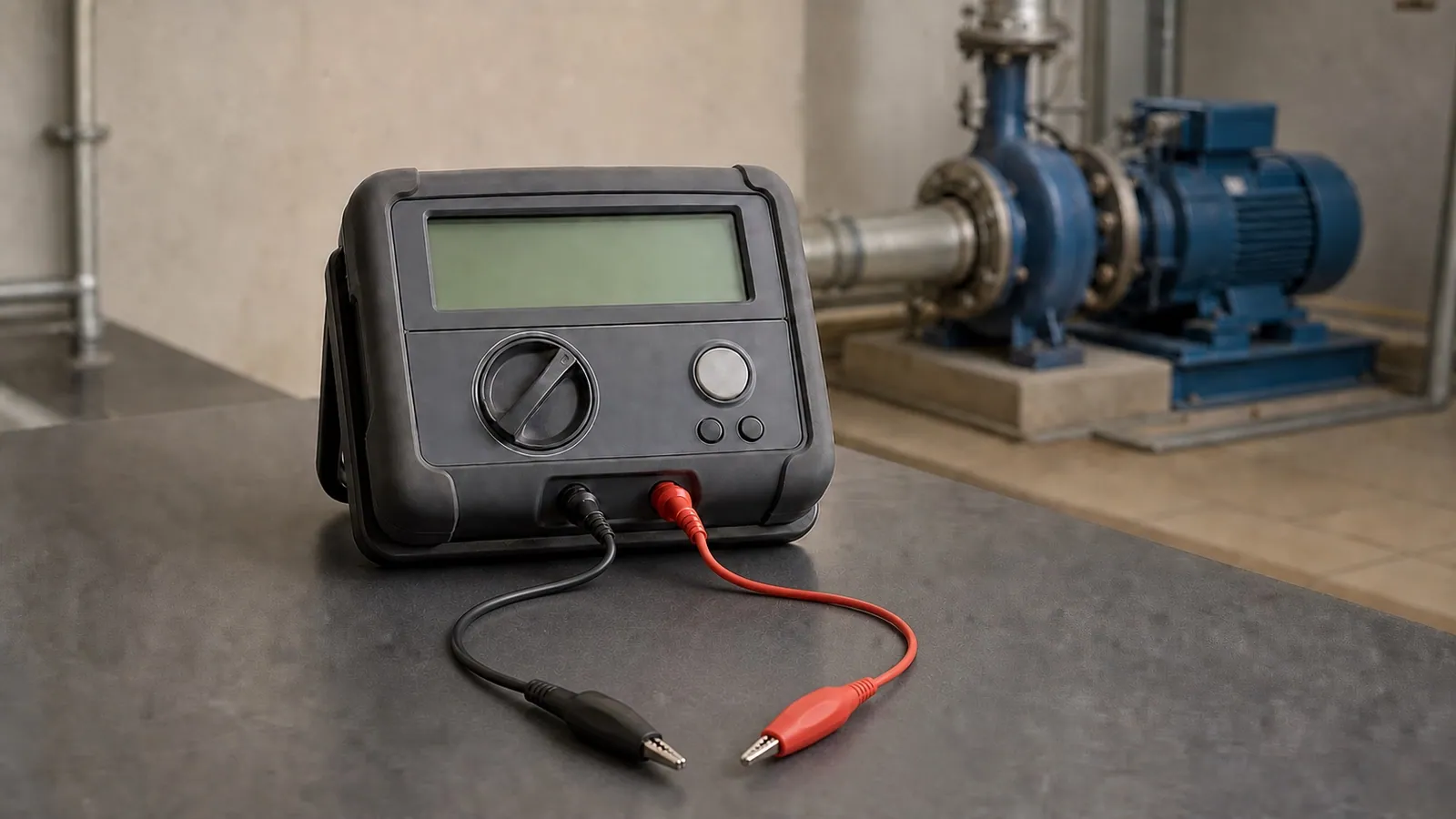
Recognition view: the tester, lead set and closed motor establish the instrument used to record insulation resistance on a controlled, isolated asset.
01 · What the tester measures
The reading describes resistance across a named insulation path.
Electrical insulation separates conductors and windings from other conductors or the equipment frame. The tester applies a controlled DC voltage to an isolated asset, observes the resulting small current and reports resistance. One megaohm (MΩ) equals one million ohms.
The selected voltage and configuration come from the asset documentation and applicable procedure. The resistance value belongs to that measurement and does not represent a percentage of equipment health.
How to read it: the tester applies the approved controlled method to one named insulation path, then reports the measured relationship as resistance.
Safety boundary: the figure identifies roles only. It omits terminals, connection locations and universal test settings.
Continuity meter or multimeter
Checks whether a conductive path exists or measures resistance using a low internal test level. Its usual output does not reproduce a controlled insulation-resistance method.
Dielectric withstand test
Uses a different stress and acceptance purpose. The asset procedure determines whether insulation resistance, withstand testing or another method is appropriate.
IEC 61557-2:2019 covers equipment used to measure insulation resistance in de-energized low-voltage systems. IEC 61010-2-034:2023 addresses safety requirements for insulation-resistance and electric-strength test equipment.
02 · What the record looks like
A timed record shows the resistance value and how it develops.
The horizontal direction represents elapsed test time. The vertical direction represents insulation resistance in megaohms. Some insulation systems show increasing resistance during a timed method as charging and absorption effects settle.
The two curves below represent the same illustrative motor under comparable configuration and temperature. Their difference supports follow-up; the graph contains no universal acceptance line.
Spot or timed reading
A spot value belongs to one stated elapsed time. A timed curve preserves how the value changed during the selected method.
DAR and PI
The dielectric absorption ratio and polarization index compare resistance at defined earlier and later times. Their relevance and timing follow the asset procedure.
Decision value
Level, timed behavior and comparison history can justify inspection, a narrower test boundary or a controlled retest after confirmed work.
IEC 60034-27-4:2018 provides procedures for insulation resistance and polarization-index measurement on rotating-machine windings. Values and curves shown here are illustrative.
03 · What makes results comparable
Each resistance value belongs to a complete test identity.
Insulation resistance is sensitive to the asset boundary and the conditions in which it is measured. A useful record preserves enough context for another qualified reader to reconstruct the comparison.
01
Named asset and test boundary
The record identifies the exact motor, cable or isolated circuit and the part of that asset included in the measurement.
A later reader can tell which insulation system the result represents and which connected equipment was outside the test.
02
Approved method and test voltage
The selected method follows the asset documentation, applicable procedure and tester capability.
The result can be compared with the correct requirement without applying a generic voltage to unsuitable electronics or insulation.
03
Elapsed time
A spot value, timed reading or ratio belongs to a stated point after the controlled DC voltage was applied.
Two records can be compared at the same elapsed time, and timed ratios can be interpreted only where the method supports them.
04
Temperature and humidity
Insulation resistance changes with temperature and can also respond to moisture or surface contamination.
Recorded conditions prevent an environmental change from being mistaken for asset deterioration or improvement.
05
Asset condition before the test
Recent operation, shutdown, cleaning, water exposure, storage and previous work can influence the insulation state.
The interpretation remains connected to the event or maintenance decision that prompted the test.
06
Comparable history
Prior results retain the same asset identity, configuration, method, elapsed time and usable condition context.
A trend becomes stronger evidence than an isolated number whose origin cannot be reconstructed.
04 · Cooling-pump motor example
A moisture event changed the evidence required before restart.
Consider a commercial property where water entered part of the chilled-water plant room during shutdown. The pump motor had no useful recent insulation baseline, and the site withheld the restart until its condition could be assessed under a controlled method.
01
Before the restart
A chilled-water pump remained out of service after moisture entered part of the plant room. The owner needed evidence before authorizing a restart.
02
Controlled test record
Qualified personnel isolated the motor under the approved method and recorded the winding-insulation result, elapsed time, test condition and temperature. The timed record was lower and flatter than the motor's comparable history.
03
Physical confirmation
Inspection found moisture and contamination in the terminal area. That observation established a credible physical condition and the corrective scope.
04
Comparable verification
After cleaning, drying and inspection, the team repeated the approved test under comparable conditions. The new resistance record changed materially, and the full return-to-service review included the other required checks.
The case and resistance behavior are illustrative. Return to service also depends on inspection, protection, restoration and functional checks required for the actual motor and installation.
05 · What the evidence can change
The record helps the team decide what must happen before restoration.
A useful result narrows the maintenance decision while preserving uncertainty. It can support inspection, segmentation of the test boundary, drying or repair evaluation, and a comparable verification record.
01
Recorded evidenceResistance is materially below the comparable asset history or changes little during the selected timed method.
Decision supportedHold the asset out of service while qualified inspection examines moisture, contamination, damage or an unsuitable test boundary.
VerificationRepeat the approved test after the confirmed condition is addressed, using comparable configuration and temperature context.
02
Recorded evidenceA combined feeder-and-motor record is concerning, while the source of the change remains uncertain.
Decision supportedPlan narrower qualified measurements so the cable, motor and connected equipment can be evaluated under their applicable methods.
VerificationPreserve the boundary of each result and confirm that the final record corresponds to the repaired or retained component.
03
Recorded evidenceSuccessive comparable records show gradual movement over time without an immediate operating symptom.
Decision supportedReview the maintenance window, environmental exposure and complementary inspection evidence before the trend reaches an asset-specific intervention point.
VerificationContinue the same documented method so future readings remain comparable and changes can be distinguished from test-condition drift.
04
Recorded evidenceThe post-work record improves under comparable conditions and the physical correction has been documented.
Decision supportedUse the result as one part of the qualified return-to-service assessment and retain it as the new maintenance reference.
VerificationConfirm restoration, required protection and functional checks, then compare the asset at the next justified test opportunity.
06 · Choosing a tester
Asset voltage, test method and retained evidence shape the instrument choice.
A compact tester can serve many LV maintenance tasks. Larger motors, generators, transformers and cables may require wider voltage capability, timed diagnostics, a guard terminal, memory or remote operation. Exact capabilities and included accessories vary by model.
Tester family
Where it fits
Selection checks
Neutral examples
Indicative hardware
Professional handheld tester
LV installations, suitable cables, small and medium motors, and routine maintenance methods that fall within the instrument range.
Confirm required test voltages, resistance range, timed functions, discharge behavior, memory and included lead set.
Larger industrial assets and procedures that benefit from memory, timed tests, PI/DAR calculation or wider test-voltage selection.
Selection: Check asset suitability, voltage range, timed and ramp functions, guard provision, data export and complete accessories.
Fluke 1537; Megger MIT2500 and comparable industrial families.
15,000–32,000 MAD
Advanced high-voltage diagnostic tester
Specialist testing of suitable higher-voltage motors, generators, transformers or cables under asset-specific procedures.
Selection: Verify the applicable method, voltage capability, current limit, safety category, guard terminal, advanced ratios, memory and remote operation.
Indicative July 2026 MAD equivalents for hardware acquisition, using approximately 1 EUR = 10.8 MAD. VAT, import, transport, specialized leads, guard accessories, software, calibration, training and professional testing services may be excluded. A complete working kit can exceed the displayed band.
The working kit must suit the asset and preserve the controlled test record.
A typical kit includes the tester, compatible rated leads and clips, suitable power, a protective case, current manufacturer documentation and recorded calibration status. A guard lead, remote probe, alternative clips, temperature measurement, memory, software or communication accessories may depend on the asset and package.
Isolation, proving dead, stored-energy control, PPE and restoration planning are mandatory site-safety prerequisites. They are not instrument accessories. Qualified personnel define and perform the method.
01
Define the decision
Name the asset, symptom or maintenance event, required evidence, proposed test boundary and applicable asset procedure.
02
Match the instrument and kit
Confirm tester range, rated leads and clips, required guard connection where applicable, power, memory, temperature record and calibration status.
03
Establish the controlled state
Qualified personnel apply the site isolation method, account for stored energy and connected electronics, and verify the asset state before testing.
04
Validate the test record
Confirm asset identity, selected method, tester configuration, lead condition, time reference, temperature, humidity and plausible initial behavior.
05
Capture and interpret
Retain the resistance value or timed curve, compare it with the applicable requirement and history, and state what the evidence supports.
06
Discharge, restore and hand over
Qualified personnel confirm discharge, restore the asset under the approved method and preserve connections, limitations, findings and follow-up.
The first useful analysis
The first review should establish whether the recorded level and timed behavior are credible for the named asset and method, whether comparable history exists, and which uncertainty requires inspection, segmentation or another test. It should also state whether the controlled test can be repeated after confirmed work.
08 · Report and review
The report keeps the resistance value connected to the test identity.
A bare number cannot show which insulation path was measured, which voltage and duration were used or whether the asset was restored correctly. The retained record should make the evidence, interpretation and limitation reviewable.
Insulation test record
Evidence that remains comparable
Asset identity
Site, equipment tag, motor or circuit, rated data and exact measurement boundary.
Controlled state
Isolation reference, disconnected or protected electronics, stored-energy controls and pre-test verification.
Test configuration
Instrument, serial reference, calibration status, method, selected voltage, duration, lead or guard arrangement and asset configuration.
Conditions
Asset temperature, ambient condition, humidity or moisture context, recent operation and relevant maintenance history.
Evidence
Spot or timed resistance record, unit, elapsed time, applicable ratio, prior comparable result and any correction basis used.
Interpretation and restoration
Supported finding, unresolved causes, inspection or work completed, discharge confirmation, restoration and required follow-up.
Before commissioning
Six questions for the proposed test
01Which asset, insulation path and maintenance decision define the test boundary?
02Which approved procedure selects the test method, voltage and elapsed time?
03How will connected electronics, stored energy, isolation and restoration be controlled?
04Does the proposed tester and complete lead set suit the asset, method and measurement range?
05Which temperature, humidity, configuration and historical records will accompany the result?
06Will the report separate measured evidence, interpretation, physical confirmation and remaining uncertainty?
Practical FAQ
Questions that often remain after an insulation-test proposal.
These answers clarify substitute instruments, connected equipment, comparison and diagnostic limits without replacing the method selected for the asset.
Usually no. A standard multimeter measures resistance with a much lower internal test level and does not reproduce a controlled insulation-resistance method. A combined insulation multimeter can perform the job when its exact test-voltage range, leads, safety rating and output meet the selected procedure.
Megger is a manufacturer name that is also commonly used as an informal name for insulation resistance testers. The practical selection still depends on the exact instrument, voltage range, resistance range, timed functions, accessories and asset procedure.
No. The value belongs to one asset configuration, voltage, elapsed time and environmental condition. Physical inspection, historical comparison and the other required electrical or functional checks remain part of the equipment decision.
The approved method must identify and protect equipment that could be affected by the applied DC test voltage. Qualified personnel follow the equipment manufacturer and site procedure when defining the test boundary; the article cannot establish a universal connected-equipment rule.
Temperature, moisture, contamination, recent operation, asset configuration, selected voltage and elapsed time can all change the recorded resistance. A useful trend retains those conditions so a genuine asset change can be separated from a changed test setup.
The result describes resistance across the selected insulation path. Narrower test boundaries, inspection or another specialist method may be required to locate the physical defect and determine the corrective work.
Conclusion
What a controlled insulation record makes possible.
Insulation resistance testing can reveal an unexpected resistance level or a change from comparable history before an isolated asset returns to service. The evidence can prioritize inspection, refine the test boundary, support corrective planning and verify whether confirmed work changed the measured condition.
01
Identify the exact insulation path and conditions represented by the result.
02
Compare spot or timed behavior with the applicable procedure and asset history.
03
Direct qualified inspection toward moisture, contamination, damage or another unresolved condition.
04
Repeat the approved test after confirmed work under comparable conditions.
05
Retain discharge, restoration and interpretation evidence for the next asset decision.
The test does not locate every physical defect, assess every protection function or guarantee future reliability. Return to service remains a qualified decision based on the complete inspection, test and restoration record.
Electrical insulation evidence
Have an insulation-test result or proposed method to review?
Send the asset details, result sheet, test conditions or proposed scope. ReneWave can explain what the resistance record supports, which conditions affect the comparison and what should be confirmed before restoration.