Voltage check
What voltage is present at this moment?
A multimeter or battery analyser can record block or string voltage. Normal float voltage can coexist with reduced delivered capacity.
A stationary-battery analyser records voltage and an ohmic indicator such as resistance, impedance or conductance at identified blocks. Those readings help rank unusual batteries and changes through time.
A controlled discharge answers a separate operating question: how much current, energy or runtime did the complete bank deliver before the approved endpoint? A credible assessment keeps both records attached to the battery identity, method and test conditions.
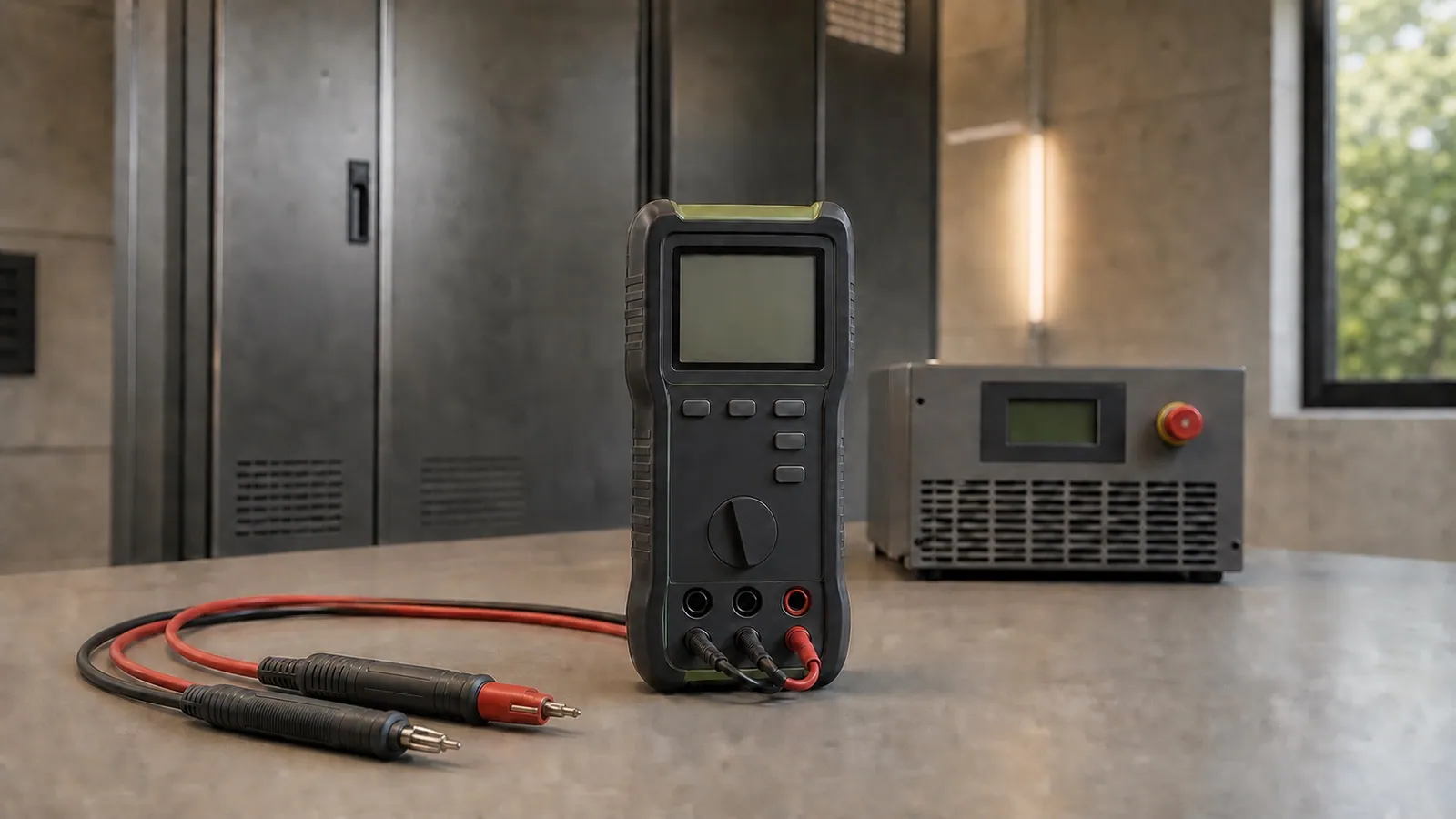
A central UPS can show normal float voltage while its batteries have changed internally or can no longer sustain the required duty. The required decision determines which record is useful.
What voltage is present at this moment?
A multimeter or battery analyser can record block or string voltage. Normal float voltage can coexist with reduced delivered capacity.
How did the UPS respond during its model-specific diagnostic?
The retained result depends on the UPS design, test load, duration and accessible data. It may identify a concern without measuring the bank duty required by the site.
Which blocks or connections differ from their peers or their own history?
A portable analyser records an ohmic indicator, voltage and often temperature. The method, instrument and comparison basis remain attached to every value.
How much current, energy or runtime did the complete bank deliver?
A controlled load preserves bank voltage, current, elapsed time and individual-block behavior until the approved endpoint or stopping condition.
How did selected battery conditions change between site visits?
Fixed monitoring can retain voltage, temperature, resistance or alarm history. Installed points and model capability define what the record covers.
Individual instruments can combine several functions. Their documented outputs and complete accessory package determine whether one platform can preserve the screening and capacity evidence required by the site.
The report below uses AC resistance in milliohms, written mOhm in the figure for compact display. Forest bars show the current visit, olive dots show the prior comparable visit, and block B27 is highlighted because it separates from both references.
Resistance, impedance and conductance are method-specific outputs. Their values cannot be merged across instruments or converted into an exact capacity result without a validated relationship.
B27 moved from its own earlier value and now sits outside the current peer group shown for this illustrative string.
Repeat the measurement, confirm conditions and examine the block and inter-cell connection evidence before defining wider work.
The screening result does not state how many minutes or ampere-hours the complete bank can deliver.
Official battery analysers commonly retain block resistance or impedance, voltage, temperature and sequence identity. Hioki BT3554-50, Fluke 500 Series and Megger BITE5 illustrate how exact methods and retained fields vary by family.
Battery readings are small enough that chemistry, operating state, temperature, contact quality and instrument method can materially change the comparison. A useful trend preserves these conditions instead of retaining a number alone.
The record identifies the UPS, string, block position, manufacturer family, age and chemistry. A VRLA result cannot be transferred to a vented lead-acid, nickel-cadmium or lithium system.
The comparison stays attached to the correct battery population and maintenance method.
Recent discharge, recharge, float condition and UPS operating state can affect the reading. The site record states the condition represented by the measurement.
A change in operating state is not mistaken for deterioration.
Battery temperature affects ohmic readings and delivered capacity. Block or ambient temperature is retained where the selected method requires it.
Current and historical results can be compared on a defensible basis.
Resistance, impedance and conductance instruments use different stimuli, frequencies and calculations. A value from one method is not silently merged with another.
Thresholds, baselines and trends remain method-specific.
Surface condition, access, pressure and inter-cell links can influence a small-resistance measurement. A repeatable exception may require a connection check before a battery conclusion.
The next action separates a poor measurement contact from a credible block or strap concern.
The strongest reference is the same identified block measured through time under a consistent method. Peer blocks from the same string can provide context when useful history is missing.
A relative screening result can rank follow-up without pretending to measure capacity directly.
Megger's published baseline guidance describes impedance as a relative indicator whose relationship with capacity is not direct. Read the baseline guidance.
The horizontal direction represents elapsed minutes. The main trace records complete-bank voltage, the load band records the controlled current, and the smaller trace follows one selected block against its peers. The approved endpoint and required duty come from the actual battery and site method.
In this illustrative case, a 72 A discharge reaches the selected endpoint after 14 minutes and has delivered 16.8 Ah. The site duty requires 20 minutes. These values explain the report structure and are not acceptance criteria for another bank.
The complete bank reaches the approved stop condition before the required operating period finishes.
B27 separates earlier than comparable blocks and becomes a priority for qualified inspection and replacement-scope review.
The owner now has measured duty evidence for continuity planning, corrective work and a comparable acceptance test.
Systems such as Megger TORKEL 900 and DV Power BLU-C retain bank voltage, current, time and capacity data; compatible cell-monitoring accessories add individual block behavior.
Consider a mixed-use commercial property whose central UPS supports network equipment, access control, communications and building controls. The bank consists of forty identified VRLA blocks and has a site requirement to sustain the declared load for twenty minutes.
The UPS shows normal float operation, and spot block voltages remain close. Those records do not establish the bank duty.
Repeat AC-resistance measurements place block B27 outside its own history and the current peer group. Qualified checks preserve temperature, probe contact and inter-cell evidence.
A planned controlled discharge reaches the approved endpoint after fourteen minutes. B27 separates from neighboring blocks before the stop condition.
Inspection, age, compatibility and the manufacturer/site policy determine whether the justified scope is a block, string or wider bank replacement.
After confirmed work and recharge, the approved duty test is repeated. The retained record establishes the delivered result and the restored backup state.
The property, string and values are illustrative. The actual method, duty, endpoint and replacement basis come from the installed battery system, approved design and applicable maintenance requirements.
The records become valuable when each one changes a maintenance decision and leaves a comparable verification path. They guide inspection and replacement planning without claiming an automatic root cause or exact remaining life.
One block rises above its own screening history while nearby blocks remain stable.
Repeat the measurement and review probe contact, temperature, voltage and inter-cell connection evidence.
Retain the repeated value and any confirmed connection work before deciding whether wider capacity evidence is required.
Several comparable blocks drift together across an ageing string.
Review bank age, duty, operating temperature and the need for a planned capacity assessment or replacement study.
Compare the next screening record using the same method and preserve any capacity result against the named string.
The controlled discharge reaches its approved endpoint before the site duty is complete.
Maintain the approved continuity plan while qualified personnel assess block behavior, compatibility, age and replacement scope.
Repeat the required acceptance or performance record after confirmed work and recharge under the approved method.
The post-work capacity record completes the required duty with stable block behavior.
Use the result as the new as-left reference and close the maintenance action with restoration evidence.
Preserve settings, conditions, delivered capacity and recharge status for the next justified comparison.
Portable screeners vary in method, voltage range, probes and data management. Capacity systems vary more widely because bank voltage, discharge current, power, cell monitoring and additional load units change the physical system required.
Routine block-by-block resistance, impedance or conductance screening with voltage and, on supported packages, temperature.
Confirm chemistry and voltage range, measurement method, four-terminal probes, sequence memory, temperature option, software and complete lead package.
Hioki BT3554-50; Fluke BT521; comparable portable battery analysers.
24,000-70,000 MAD
Larger stationary banks where inter-cell resistance, wider voltage range, stronger data management or discharge support changes the survey.
Confirm supported chemistries, module voltage, inter-cell method, current and temperature accessories, parallel-string behavior, storage and export.
Megger BITE5 and BITE5 Advanced; comparable bank-trending systems.
35,000-100,000+ MAD
Capacity or duty testing where a stable load, bank current, endpoint control and individual cell or block behavior must be retained.
Match bank voltage, required current or power, load profile, ventilation, stop controls, cell monitor, software, additional load units and continuity plan.
Megger TORKEL 900 with BVM; DV Power BLU-C with supported cell-monitoring modules.
Project-priced
Indicative July 2026 MAD hardware references use approximately 1 EUR = 10.71 MAD and 1 USD = 9.13 MAD. VAT, import, transport, probe packages, temperature accessories, load extensions, cell-voltage modules, software, calibration, training and professional services may be excluded. Overlapping bands reflect package and capability differences. Capacity systems remain project-priced because voltage, current, power and cell-monitoring scope materially change the configuration. Exchange basis: Bank Al-Maghrib.
A screening visit needs repeatable probes, battery identity, temperature context and an export path. A capacity campaign also needs a load system, block monitoring where required, a continuity arrangement, controlled stop conditions, recharge and documented restoration.
Battery analyser with the required resistance, impedance or conductance method and voltage range.
Compatible four-terminal probes or clips suited to the actual battery access and connection form.
Temperature measurement where required by the method, plus block and string identifiers.
Working memory, sequence profiles, software or export route, current documentation and calibration status.
Controlled load system matched to bank voltage, planned current or power and the selected duty profile.
Bank-voltage and current measurement, plus individual cell or block voltage monitoring where the plan requires it.
Suitable load extensions, power, ventilation, stop controls, storage and reporting software.
Approved test plan, continuity arrangement, operating observers, recharge plan and restoration record.
Qualified personnel control battery access, high fault-current exposure, temporary loading, ventilation, protective measures, stop conditions and the approved manufacturer method.
The site plan states how critical loads remain protected, who can stop the campaign, how the bank is recharged and which evidence confirms that the normal backup arrangement has been restored.
The first review should identify repeatable block or connection exceptions, state whether comparable history exists, and show whether the bank completed the selected duty. It then names the inspection, capacity evidence, replacement review or repeat test needed next.
A useful handover allows another qualified reader to reconstruct the screening comparison, discharge duty, corrective decision and restored operating state. A health score or isolated pass label cannot provide that traceability.
Primary method and safety anchors include IEEE 1188-2025 for stationary VRLA batteries, IEEE 450-2020 for vented lead-acid batteries, IEC 62485-2 for stationary battery safety, and IEC 60896-21 for stationary VRLA test methods.
These answers clarify substitute instruments, remaining-life claims, UPS self-tests, discharge scope, replacement choices and chemistry boundaries.
Impedance, resistance or conductance screening can identify unusual blocks, connection concerns and changes that deserve follow-up. A controlled capacity record can establish whether the complete bank delivered its approved duty under the documented test conditions.
Prioritize repeat measurements and qualified inspection using identified block evidence.
Decide whether a capacity campaign is needed before relying on assumed backup time.
Plan replacement scope using bank age, compatibility, physical findings and delivered duty.
Verify corrective work with a comparable screening or capacity record.
Restore the UPS with recharge, as-left condition and test evidence available for review.
These tests do not calculate exact remaining life, locate every internal defect, validate the UPS electronics or guarantee future availability. Their business value comes from proving the current duty, directing justified work and preserving a comparable record after correction.
Send the UPS and battery details, block readings, discharge record or proposed test scope. ReneWave can explain what the evidence supports, which conditions affect the comparison and what should remain after restoration.
 RENEWAVE
Energy systems, held to standard.