The first clue is the homeowner’s actual discomfort.
Many homeowners arrive with one of four sentences: the electricity bill is too high, solar looks interesting, outages are uncomfortable, or a quote arrived and the decision feels unclear. Each starting point is valid, and each one can lead to a different first action.
A home may need a solar study, a backup-load discussion, a quote review, or a clearer look at household behavior. The first conversation should identify which path is useful before turning the problem into panels, batteries or equipment names.
This matters because a home can spend money in the wrong order. A solar quote may be discussed before anyone understands why the bill rose. A battery may be priced before anyone names the loads that should stay on. A homeowner may compare two proposals without seeing that each one assumes a different roof, production model, battery purpose or after-sales support path.
A useful first conversation is practical: describe the discomfort, then let the evidence sort the first decision. Is the problem mostly consumption behavior? Is it a roof and solar question? Is it outage continuity? Is it a weak quote? Or is the home missing basic explanation after a previous installation?
That first separation makes the article practical. A home with a sudden bill jump after summer cooling needs a different conversation from a home with a stable high bill all year. A villa with frequent short outages needs a different backup discussion from a villa that wants evening battery use. A quote that includes batteries, export value or very clean payback numbers needs the assumptions checked before the homeowner treats it as a decision.
The bill usually has a household story behind it.
A monthly bill is the result of many small decisions: when cooling runs, how hot water is prepared, when laundry is done, whether pumps run every day, how many rooms are cooled, and whether family life happens mostly during the day or evening.
That is why the same total monthly consumption can lead to different recommendations. If consumption is concentrated during sunny hours, solar may match the home more naturally. If the home is mostly active at night, the design needs a more careful self-consumption discussion. If the bill is driven by uncontrolled comfort habits, solar may reduce part of the bill while leaving the underlying waste untouched.
Two villas can have similar appliances and very different bills. One may cool bedrooms with open doors, run a pressure pump frequently, heat water at random times and shift most consumption into the evening. Another may control rooms, schedule heavy appliances, keep hot-water use predictable and have more daytime consumption. The second home is easier to analyze, easier to size for solar, and easier to train after a solution is installed.
One family cools a room while windows are open, then switches the unit off and on aggressively because the room never feels stable. Another family uses the thermostat, closes the room properly and keeps a calmer temperature. The equipment may be similar, but the first home gives it a much harder job.
Hot water creates the same kind of confusion. Randomly unplugging a water cylinder can feel like a saving habit, but repeated cooling and reheating may not create the result the homeowner expects. The useful question is how the home actually uses hot water, when it needs it, and whether the routine is stable.
Laundry and dishwashing have the same timing issue. If most heavy use happens after sunset, a solar system can still produce well during the day while the home buys more electricity later. Solar can still be useful, but the home needs a self-consumption discussion before anyone presents production as savings.
A useful first review also asks what changed. Did the bill rise after a new appliance, a new tenant routine, a pool season, a heat wave, a water-pressure issue or a different hot-water habit? The answer may only be a clue, but it tells the reviewer where the guessing should stop.
Common reasons a home bill gets high.
The cause can sit in behavior, equipment, the building, roof constraints or simply in missing evidence. A first review should stay wide enough before recommending solar or batteries. The purpose is to identify the strongest driver so the first investment answers the real problem.
Read the map as a working diagnostic frame. HVAC habits can raise consumption without a visible fault: open windows, poor room zoning, aggressive thermostat changes or frequent on/off cycling all make comfort harder to stabilize. Hot-water habits can create repeated reheating or oversized availability for a routine with limited demand. Pumps and appliances add load quietly because they feel less visible than cooling, especially when pool, pressure, laundry or dishwashing schedules drift into expensive or poorly matched hours.
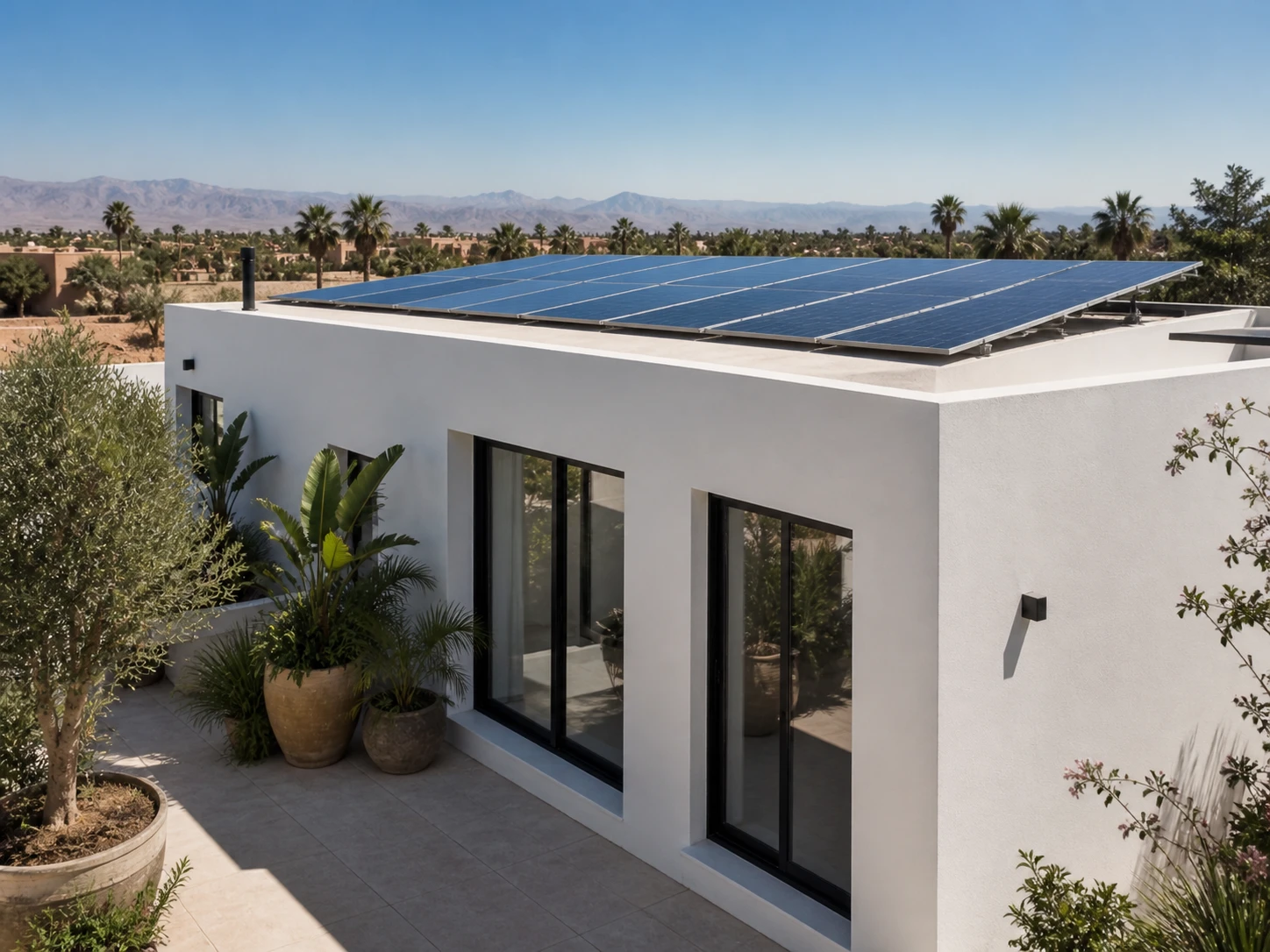
The roof is also part of the story. A Moroccan villa roof may be a terrace, laundry area, water-tank zone, access route or future maintenance space. Treating it as empty panel space can create a design that looks strong on paper but conflicts with real household use.
When these points remain unchecked, the home still lacks a technical or consumption baseline. Quote comparison becomes fragile because each provider may be guessing from a different starting point.
A strong first answer names the likely drivers and the missing evidence. It may say the bill should be reviewed against the last few months, that the solar question depends on daytime use, that backup needs a load list, or that the roof needs a visit before any panel layout is trusted. That is far more useful than jumping straight to a product.
What a good company should check before proposing a solution.
The first step should feel investigative. A provider should read the bill, ask how the home is occupied, understand cooling and hot-water habits, review roof context, ask about outage expectations and identify whether the next step is solar, quote review, backup planning or consumption correction.
A homeowner rarely needs a complicated audit for every villa. The first review should be honest about what is known and what is still assumed. A few bills, roof photos, a clear description of the routine and an existing quote can already reveal whether the conversation is mature enough for equipment sizing.
The provider should also separate owner-level observations from qualified technical work. A homeowner can describe symptoms, share photos, explain routines and list outage priorities. Panel access, wiring checks, protection changes and unsafe checks belong with qualified technical work.
The quality of this step shows in the questions. A weak first discussion asks only for roof area and monthly bill value. A better one asks when the home is occupied, whether cooling and hot water are seasonal, whether pumps run automatically, whether outages affect access or refrigeration, and whether an existing quote already assumes export, batteries or payback. Those questions are not paperwork; they protect the homeowner from a proposal that sounds precise but rests on guesswork.
The output of this first review should be a direction: adjust habits first, review a quote, define backup loads, check roof fit, or move into a solar study with assumptions clearly stated.
In practical terms, that direction should be written clearly enough that the homeowner can repeat it: "we need bills and a roof check before sizing," "backup is about these selected loads," "the quote needs an assumption review," or "behavior changes should be tried before spending more." If the homeowner leaves the conversation with only a price, the first review did not do its job.
Residential solar starts with consumption, roof reality and legal assumptions.
Solar can be a strong answer for a home or villa. A serious quote is built from bills, daytime use, roof constraints and what happens to solar energy when the home is not using it.
Production and savings are different metrics. Production is what the system may generate. Savings depend on how much of that energy the home uses directly, whether battery storage has a defined purpose, and whether any export or payment assumption has been confirmed for the exact project.
A villa with daytime occupancy, pool or pump loads, home-office equipment, daytime cooling or predictable appliances may have a better direct-use story than a villa that is mostly empty during the day and active at night. That alone does not decide the project, but it changes how the system should be read. The useful question is how much of the roof production the home can actually use while the system is producing.
Roof reality is equally important. Parapets can shade panels. Water tanks can block usable areas. Terrace use can limit where modules should go. Waterproofing and access paths matter because the roof still needs to be maintained after installation. A smaller clean area may be more serious than a crowded layout that ignores shade, access and future work.
The diagram separates three ideas that are often merged too quickly in residential quotes. First, the home has a consumption rhythm: daytime use, evening use, hot water, pumps, cooling and occupancy. Second, the roof has constraints: shade, tanks, parapets, terrace use and safe access. Third, the proposal has a financial assumption: what happens to unused solar energy while the system is producing.
As of May 31, 2026, residential low-voltage surplus injection, export payment or net-metering-style compensation must be confirmed for the exact project before it appears in savings logic. Morocco is moving the self-production framework forward, and buyer-safe residential planning should remain self-consumption-first until the exact project framework is confirmed.
For context, review ANRE's surplus-tariff announcement for the March 1, 2026 to February 28, 2027 regulatory period, the Energy Partnership summary of the new self-generation implementing decree, and the Moroccan Ministry note on medium-voltage network opening: ANRE surplus tariff self-generation decree summary medium-voltage network note.
The practical conclusion is conservative: unused solar energy should only be counted as financial value when the export, compensation or zero-export framework is confirmed for that exact home. A good residential quote can still be attractive without that assumption, but the savings logic must be honest.
Oversizing deserves discipline. More panels can look attractive when the roof is large, but if the home cannot use the extra production directly and the export framework is not confirmed, the larger system may improve the production number without improving the decision. A serious residential solar proposal should show why the size fits the home and the roof together.
Backup begins with what should stay on.
Battery planning begins with the load list: what must stay on, what would be useful if the budget allows, and what usually remains off during an outage.
Backup language is easy to misunderstand. A homeowner may hear “hybrid” or “battery” and imagine the whole villa continues normally. In practice, serious backup planning names the protected loads, explains what remains off, and states the assumptions behind runtime. Without that list, battery capacity is just a number.
For a villa, selected backup often means key lighting, internet, refrigeration, gate or access, and possibly one comfort zone or a pump if justified. Heavy HVAC, ovens, pool equipment and electric water heating need careful discussion because they can change the project completely.
Runtime depends on more than the battery nameplate. It depends on which loads are connected, how those loads behave during the outage, whether the outage happens at night or during solar production, and how the household reacts when power is limited. A refrigerator and router create a different backup problem from a pump, full villa cooling or electric cooking. The design conversation should make that distinction before equipment is priced.
Homeowner expectations should be trained early. A backup system can be useful and comfortable when the household understands its limits. It becomes frustrating when the home expects a normal-grid experience from a system that was designed for selected loads.
A serious quote makes its assumptions visible.
If a homeowner already has a quote, the useful review checks more than price. It asks what bills were used, what roof assumptions were made, whether shade and access were checked, what the battery is supposed to do, what monitoring is included, and which exclusions remain.
Any claim about savings, payback, battery autonomy or export value should be traceable to visible assumptions. A clean-looking quote can still be weak if it hides the logic behind production, self-consumption, support and after-sales responsibility.
For a home, the most useful quote review usually checks five layers. The bill basis: which months and habits were used. The roof basis: which surfaces, shade and access constraints were assumed. The system basis: on-grid, hybrid, battery-ready or backup-oriented. The financial basis: what is counted as savings and what happens to unused solar. The support basis: monitoring, commissioning, warranties, documentation and who answers after installation.
A serious quote should make the decision easier to understand. It should name the system architecture, explain why batteries are or are not included, show what production estimate was used, clarify what happens to unused solar energy, and state what is excluded. It should also show who handles monitoring, commissioning records, warranty documents and support after installation.
Two quotes that hide those points answer different questions. The cheaper one may be missing scope. The more expensive one may include useful support. Or both may rely on assumptions that still need proof. The quote review should reveal that before the homeowner signs.
Expert review creates value without drowning the homeowner in engineering. The goal is to translate the proposal into plain decisions: what is confirmed, what is assumed, what should be checked on site, what should be excluded from savings logic, and what support the homeowner can expect after the system is live.
Durability depends on handover and habits.
Solar, batteries and controls still depend on basic operating discipline. If a home installs a system but continues cooling open rooms, running heavy loads at poor times, or misunderstanding backup limits, the result may feel disappointing even when the installation is technically sound.
Durability is partly technical and partly human. The home should know how to read the monitoring screen, what the system is designed to do, where its limits are, which loads are backed up, and which habits should change. Without that handover, the same confusion often returns later as “the system is not working” even when the real issue is expectation or usage.
A good implementation includes handover and simple training. The household should understand how to use the system after the installation team leaves.
Residential application logic
A useful follow-up can be simple: check the first bills after installation, review monitoring access, confirm cleaning and basic maintenance expectations, and revisit backup behavior after the first outage. For a villa, the aim is homeowner clarity, with business maintenance contracts reserved for business sites.
Solar, backup, quote review or consumption review?
The right first step depends on what is unclear. The application guide comes before the deeper topic guides so the situation is read before the homeowner chooses between solar, battery, quote review or behavior correction.
If the bill is the pain point, begin with consumption and habits. If outages are the pain point, begin with critical loads and runtime expectations. If the homeowner already has a quote, begin by checking the assumptions. If solar is the interest, begin with roof reality, self-consumption and legal/export assumptions before sizing.
This order protects the homeowner from approving a solution that answers the wrong question. It also makes the later technical guide more useful, because the reader arrives with a clearer objective instead of trying to learn everything at once.
The path can also change as evidence appears. A bill review may reveal that solar is a good next step. A quote review may reveal that the system size is reasonable but the export assumption needs proof. A backup discussion may show that the family needs selected loads instead of a large whole-home promise. Good guidance keeps the path flexible until the basis is clear.
Information that makes the first answer useful.
Send the evidence that helps avoid guessing. The file can be imperfect. The goal is to understand the home quickly enough to avoid a generic answer.
If some items are missing, send what you have. A few bills and honest roof photos are already more useful than a conversation that starts with “how many panels do I need?”
Avoid solving the wrong problem.
Buying solar before understanding the bill.
Solar can be useful, but the system should follow real consumption, roof reality and self-consumption. If the home wastes energy through habits or uncontrolled loads, the project starts from a weak baseline.
Counting export value before it is confirmed.
Residential low-voltage export, payment, compensation or zero-export requirements must be confirmed for the exact project before they appear in savings logic.
Treating backup as the whole home.
A battery conversation should start with selected loads and expected runtime. Whole-home promises without a load list usually create confusion.
Comparing quotes by price and panel count only.
Two quotes can hide different assumptions about roof shade, self-consumption, batteries, monitoring, warranties, exclusions and after-sales support.
Use value numbers to decide what deserves modeling.
Residential value depends on self-consumption, roof reality and household behavior. A stronger solar screen usually has useful daytime consumption, a clear roof and limited storage dependency. A battery-led case should be read first through comfort and continuity, then modeled financially. Handover value comes from avoiding a system that technically works while the family still misunderstands production, backup or usage habits.
A strong residential self-consumption project without storage is usually worth detailed modeling when the early screen sits around this range. Use the range only as an early modeling screen. Bills, daytime use, roof reality, export assumptions and production modeling still decide the case.
Best early candidates use energy during the day: cooling, pumps, home office, appliances or predictable routines that match solar production.
When batteries lead the project, the first value is comfort and continuity: key lighting, internet, refrigeration, access, selected pumps or a limited comfort zone. Financial payback is usually slower and depends on protected loads, runtime, battery size and household behavior during outages.
Use battery scope after the household names what should stay on and what can remain off.
Residential value is also counted through avoided confusion: wrong sizing, hidden export assumptions, unclear battery purpose, weak monitoring handover, uncomfortable outage expectations and habits that keep bills high after installation.
The useful handover question is whether the family understands production, self-consumption, backup limits and the habits that affect results.
How ReneWave reads a home or villa request.
ReneWave starts by separating the pain point from the product. A high bill may need behavior review, solar, or both. An outage concern may need a critical-load list before batteries. A quote may need assumption review before negotiation.
The objective is a durable decision: the home understands what changed, what the system can do, where its limits are, and how to operate it after handover.
For homes and villas, ReneWave reserves business maintenance contracts for business sites. The residential path is lighter and more practical: read the home, clarify the first decision, design around real use, document the assumptions, and make sure the homeowner knows how to live with the solution after it is installed.
Questions homeowners ask first.
Related guides & services.
Solar Systems for Homes and Villas
System types, sizing, batteries, backup circuits, quote logic and payback scenarios.
Open Buyer guideHow to Read a Solar Quote
Understand scope, assumptions, equipment, warranties and financial claims before signing.
Open Solar guideReading a Solar Production Estimate
Separate kWp, kWh, production curves, losses, self-consumption and savings assumptions.
Open Backup guideBackup Power and Critical Loads
Define what should stay on before batteries, hybrid systems or backup equipment are sized.
Open Talk to usContact ReneWave
Send bills, roof photos, an existing quote or backup expectations for review.
Open